Seville Holy Week processions: how long each one takes to pass and how to choose which to see
Guides give the time a procession leaves and the time it returns, but not how long you need to stand on the pavement to see the whole thing. Using the 2026 times, this page works it out and helps you choose which to watch.
A Seville procession does not simply go by, it settles in. Between the lead cross (cruz de guía) that opens it and the canopied float (palio) that closes it, the times published for 2026 show between 40 minutes and 1 h 20 at a single point in the street.
That figure appears in no programme, yet it decides how many processions fit into an afternoon. This page works it out brotherhood by brotherhood and turns it into a rule for choosing which to see. The dates and full calendar are in the main guide to Holy Week in Seville.
What exactly is a procession in Seville?
Each brotherhood (hermandad) leaves its church, crosses its neighbourhood, enters the Carrera Oficial (the official route) at La Campana, makes its station of penance in the Cathedral and returns home. There is no single parade: dozens of independent processions criss-cross the city throughout the week.
A procession opens with the lead cross, followed by the nazarenos (robed penitents) and one or two floats (the mystery or Christ float, and the palio float with the Virgin), with their band behind. That is why serious programmes give two times for the return to the church: the lead cross and the palio.
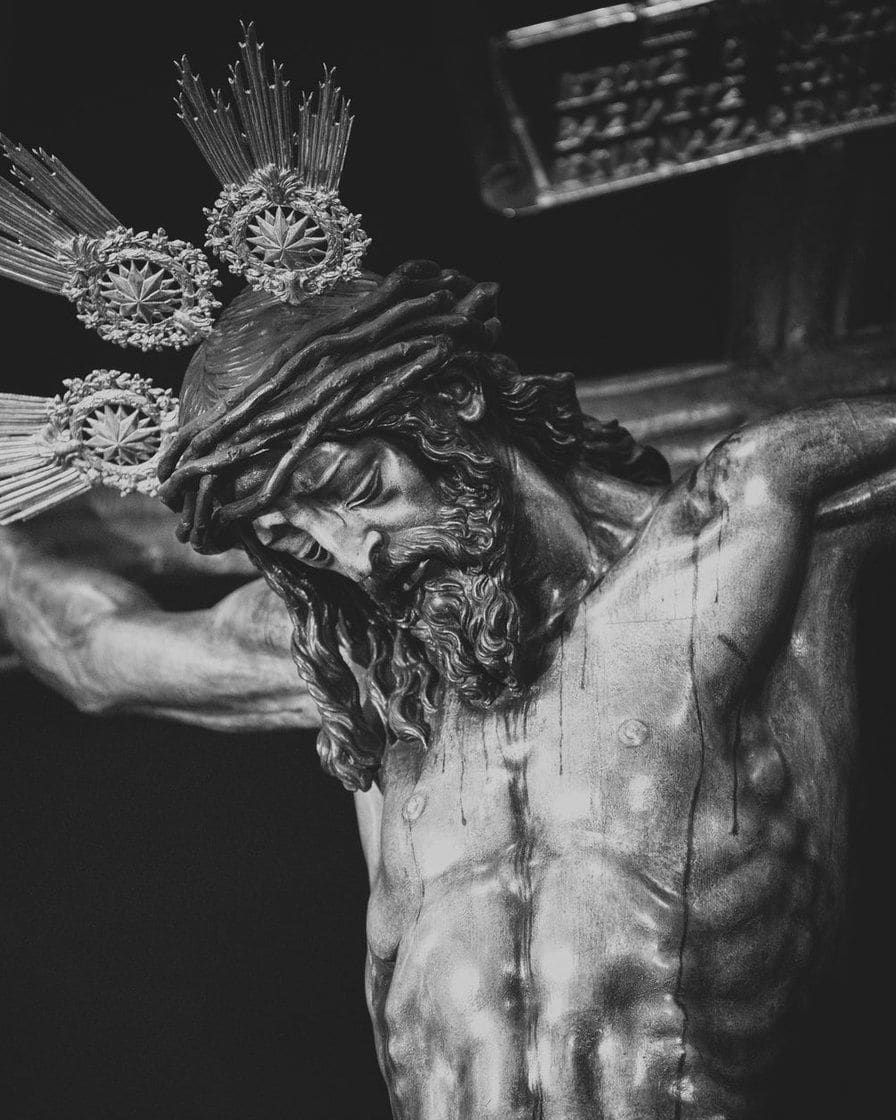
How long does a procession take to pass in front of you?
The gap between the lead cross going back in and the palio going back in measures how long the whole procession takes to pass through a doorway. Using El País's times of 27 March 2026, the calculation gives this:
| Brotherhood | Return to the church, 2026 | Time to pass |
|---|---|---|
| La Borriquita (Palm Sunday) | The lead cross goes back in at 21:15 and the palio at 22:00 | 45 min |
| Jesús Despojado (Palm Sunday) | Leaves at 14:20, La Campana at 16:30, the Cathedral at 17:56, lead cross back in at 22:00 and palio at 22:45 | 45 min |
| Polígono de San Pablo (Holy Monday) | Leaves at 11:15, La Campana at 16:25, the Cathedral at 17:50, lead cross back in at 0:35 and palio at 1:35 | 1 h |
| El Beso de Judas (Holy Monday) | Leaves at 14:45, La Campana at 16:59, the Cathedral at 18:24, lead cross back in at 22:15 and palio at 23:15 | 1 h |
| Los Negritos (Maundy Thursday) | Leaves at 15:00, La Campana at 17:40, the Cathedral at 19:05, lead cross back in at 22:00 and palio at 23:20 | 1 h 20 |
| El Sol | Between 22:15 and 22:55 | 40 min |
| La Resurrección (Easter Sunday) | The lead cross goes back in at 15:30 and the palio at 16:30 | 1 h |
It is an approximation: in the street the procession stretches or bunches up with its stops, and the figure only holds for the final stretch. But it gives the order of magnitude that no guide publishes, and that is enough to plan with.
How many processions fit into an afternoon?
Not many. If each procession fills a pavement for around an hour, and moving between two points in the centre takes far longer than on a normal day, the realistic figure is two or three processions in an afternoon, not five. Local guides talk of sessions of 2 to 4 hours at a stretch in the same spot.
The practical rule follows on its own: pick a spot and let the brotherhoods come to you, rather than chasing them. Cutting through a procession is not done, and going round it via closed streets can take longer than the procession itself.
A procession watched with someone explaining the order of the cortège makes twice as much sense. Brotherhood-themed guided tours in Seville explain what each section is before it passes in front of you.
See guided tours and activities in Seville →Affiliate link: booking through it helps keep this guide going, and costs you nothing extra.Which procession should you choose for the time you have?
- A spare hour: the return of a short brotherhood to its church, with the lead cross and the palio about 45 minutes apart, such as La Borriquita or Jesús Despojado in 2026.
- A morning: La Resurrección, the only day that takes place in daylight (in 2026: leaving at 8:30, the Campana at 10:55, the Cathedral at 12:25 and the palio back in at 16:30).
- A whole day: a long neighbourhood brotherhood such as San Pablo, which leaves before midday and returns after midnight. You can see it leave, have lunch and come back for its return.
- A first time without the crush: the vísperas (the days before Palm Sunday), with neighbourhood processions that do not go along the Carrera Oficial.
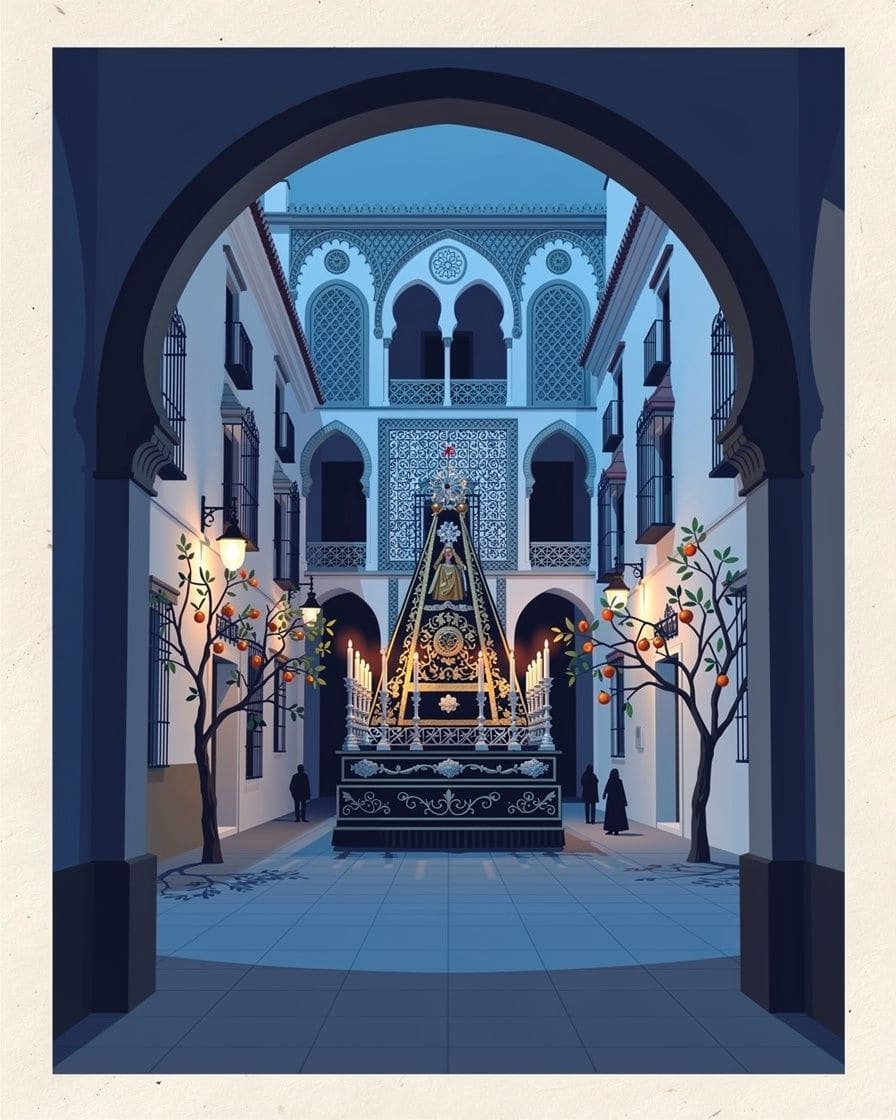
Which processions go out before Palm Sunday?
Those of the vísperas, on Viernes de Dolores and Sábado de Pasión (the Friday and Saturday before Palm Sunday). They are neighbourhood processions watched mostly by locals. The departure times published by Idealista on 17 March 2026:
- Bendición y Esperanza: at 17:00, from the parish church of Jesús Obrero.
- Pino Montano: at 17:45, from the parish church of San Isidro Labrador.
- La Misión: at 18:15, from the parish church of San Antonio María Claret.
- Dulce Nombre de Bellavista: at 18:30, from the parish church of the Sagrado Corazón.
- Cristo de la Corona: at 19:00, from the Sagrario of the Cathedral.
- Pasión y Muerte: at 20:00, from the parish church of Nuestra Señora del Buen Aire, in Triana.
These are times of leaving the church, not of passing through the centre. The source does not say which brotherhood goes out on the Friday and which on the Saturday, so check that year's programme before you set off.
If each procession asks for an hour on the pavement, sleeping near your chosen spot is worth more than sleeping near everything. A place to stay within walking distance of La Campana or of your brotherhood's neighbourhood saves cutting across processions to get back.
See places to stay for the Holy Week dates →Affiliate link: booking through it helps keep this guide going, and costs you nothing extra.Does anything change in 2027?
Holy Week 2027 is expected to run from 21 to 28 March 2027, but brotherhood-by-brotherhood times had not been published as of September 2026. The ones on this page are from 2026 and serve as an order of magnitude, not as an appointment.
Changes from one year to the next are real. In 2026 the Palm Sunday Carrera Oficial brought its start forward by 30 minutes, to 15:35, according to La Voz del Sur and El Confidencial. And two outlets give different sequences for La Borriquita: El País's, above, and that of 20minutos: leaving at 14:35 and back in at 18:25.
How many people watch the processions?
There is no recent count. The last study with a published method, from 2009, estimated around 425,000 people a day and 909,000 people, around 215,000 of them from outside Seville and its metropolitan area in total. It is an old estimate, not a 2026 figure.
What is measured every year is public transport, and the guide to the metro at Holy Week gives those figures with their limits.
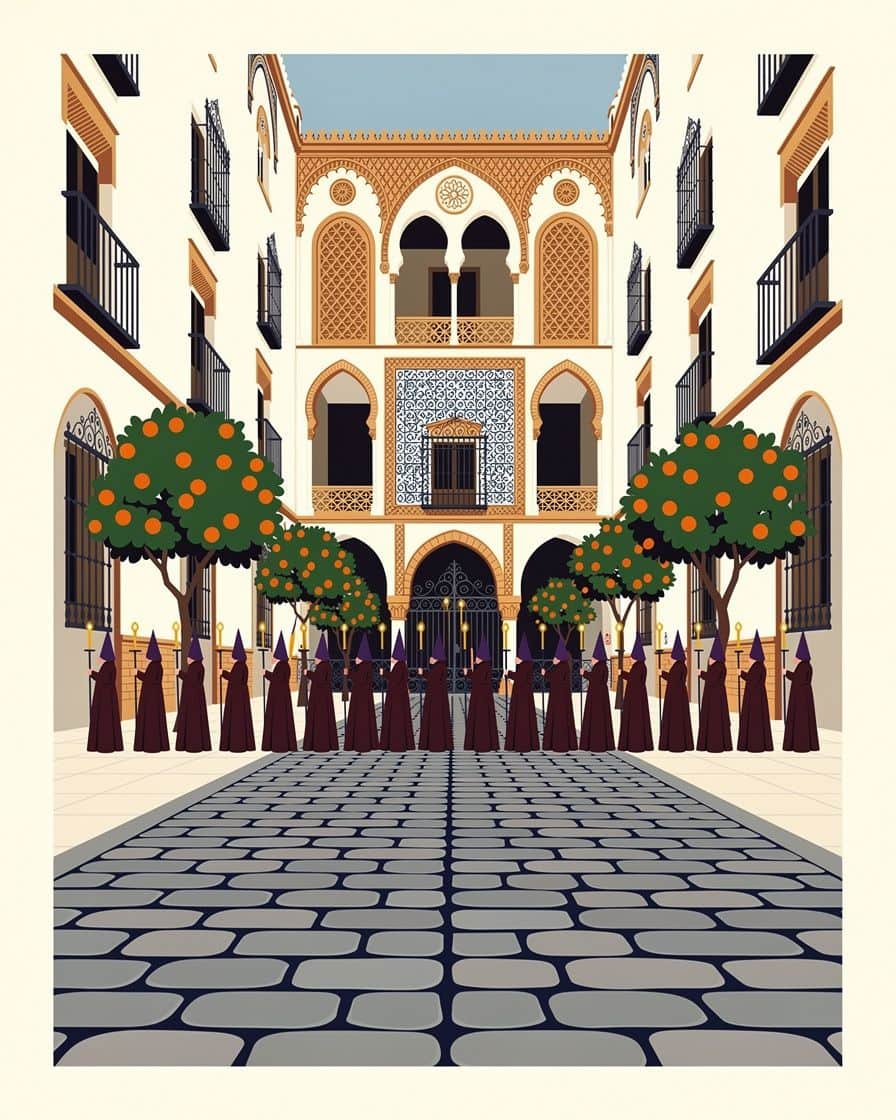
Missing from every source
- How long each procession takes to pass a given point: here it is deduced from the return times, nobody publishes it.
- The 2027 times, which the Consejo de Hermandades publishes in winter.
- A crowd curve by hour or by procession.
- The day of El Sol: the sources consulted disagree, and this page does not assign it one.
For the route street by street, the 2026 itinerary; for each day's time slots, the 2026 times; for a seat on the Carrera Oficial, the guide to chairs and boxes.
Outside Holy Week, the brotherhoods' churches can be visited without queues, often with their floats on view. A good plan if you want to see the images without the crowds.
Compare places to stay in Seville →Affiliate link: booking through it helps keep this guide going, and costs you nothing extra.Sources
- El País: Seville Holy Week programme, times of leaving, La Campana, Cathedral and return, 27 March 2026.
- Idealista: vísperas and routes for 2026, 17 March 2026.
- La Voz del Sur (15 March 2026) and El Confidencial (26 March 2026): earlier start of the Palm Sunday Carrera Oficial.
- 20minutos: La Borriquita timetable, 2026.
- ArteSacro: impact and attendance study, 7 April 2010.
- Consejo General de Hermandades y Cofradías and Visita Sevilla: times, routes and programme for 2026.
The passing times are this guide's own calculation from the published times, not official data.
Frequently asked questions
How long does a Holy Week procession in Seville last?
How many processions can you see in an afternoon in Seville?
Which is the easiest procession to see in Seville?
Are the 2027 procession times out yet?
Álvaro Pineda
Álvaro worked for seven years as a guide at the Alcázar before he started writing. He walks his itineraries with a stopwatch and cuts whatever does not fit into a real day. He would rather say a monument is not worth it than pad out a list.