Seville Holy Week 2026 programme: what goes out each day, from the eve days to Easter Sunday
Ten days, 71 brotherhoods and an official document approved by decree. How the 2026 programme is structured, what goes out each day with sample times, how it compares with 2024 and 2025, and what official figures lie behind it.
The official programme for Seville's Holy Week 2026 is the nómina (the official list) of the General Council of Brotherhoods and Confraternities: a document approved by decree on 15 March 2026 that sets, for each brotherhood, its departure time, its passage along the Carrera Oficial and its return. Everything the press publishes comes from it.
This page explains how that programme is structured day by day, with sample times, and what official figures lie behind each edition. For street-by-street routes see the 2026 itinerary, and to download the document, the programme PDF page.
Which days does the 2026 programme cover?
The main week runs from 29 March to 5 April 2026. Before it come the eve days: Viernes de Dolores, 27 March, and Sábado de Pasión, 28 March 2026. In the middle is the Madrugá, the night of Thursday 2 to Friday 3 April 2026.
The pattern repeats every year on different dates: from 24 to 31 March 2024, from 13 to 20 April 2025. In 2026, 71 brotherhoods make their station of penance, and 46 brotherhoods announced changes of time or route compared with the year before.
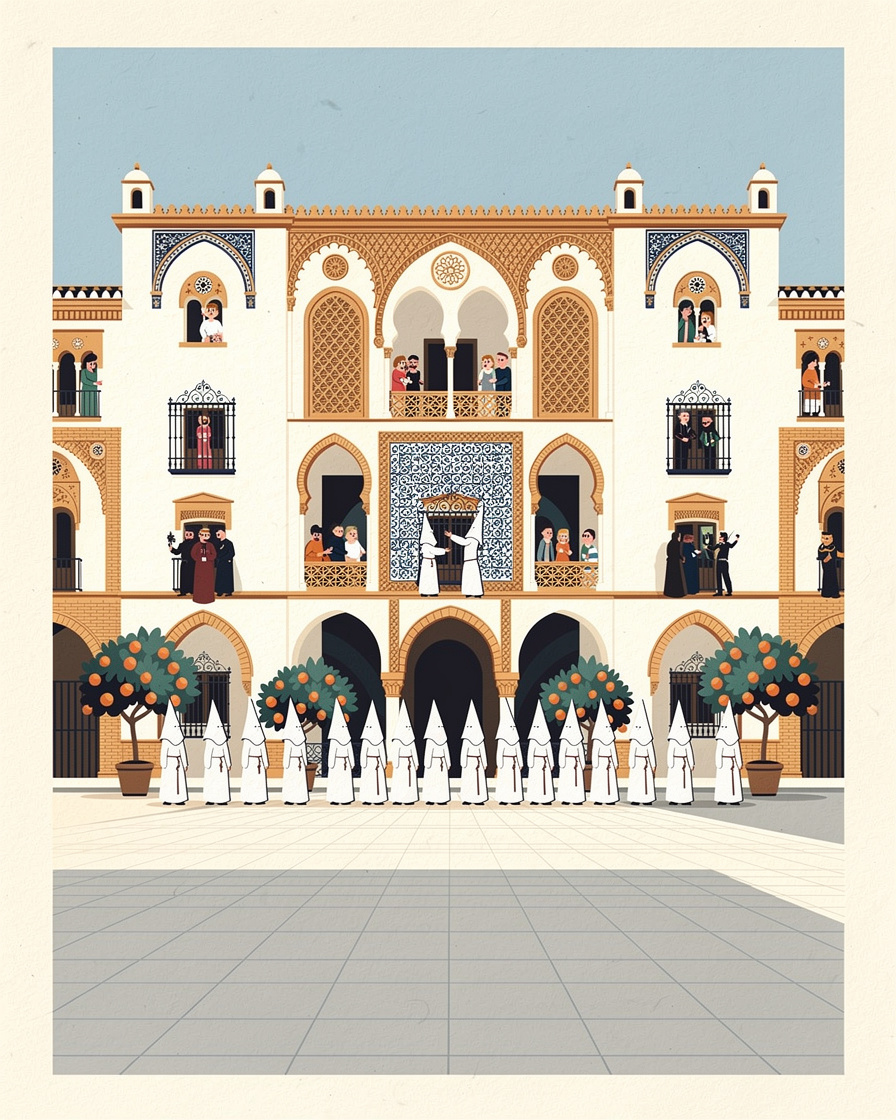
What goes out each day, and at what time?
Viernes de Dolores and Sábado de Pasión. Brotherhoods from outlying districts go out: Polígono Sur, Bellavista, Torreblanca, Parque Alcosa. These are the least crowded days, with a more local audience.
In 2026 the leading cross of Bendición y Esperanza went out at 17:00, the Cristo de la Corona at 19:00, Padre Pío was leaving at 15:10 and back in at 0:30 and Torreblanca leaving at 16:45 and back in at 1:00.
Palm Sunday. The Carrera Oficial opens. La Borriquita: leaving at 14:15, the Campana at 15:35, the Cathedral at 17:00 and the palio back in at 22:00. La Cena: leaving at 14:00, the Campana at 15:50, the Cathedral at 17:20 and back in between 21:15 and 22:00. Also La Paz and El Amor, both highly recommended for a first time.
Holy Monday, Tuesday and Wednesday. A steady rhythm from early afternoon until the small hours. El Cerro, on Holy Tuesday, sums up the long brotherhoods: leaving at 11:40, the Campana at 16:40, the Cathedral at 18:05 and back in between 1:00 and 2:00. Departures cluster between 12:00 and 16:00 and the passage along the Carrera Oficial between 16:30 and 22:30.
Maundy Thursday and the Madrugá. The Thursday afternoon brotherhoods, then from midnight those of the great night: Gran Poder, Macarena and Esperanza de Triana, among others, with departures between 0:00 and 3:00 and returns between 7:00 and 13:00. Every programme gives it its own PDF.
Good Friday, Holy Saturday and Easter Sunday. The most austere days. El Sol, on Holy Saturday: leaving at 12:45, the Campana at 17:15, the Cathedral at 18:40 and the palio back in at 22:55. La Resurrección closes the programme in the morning: leaving at 8:30, the Campana at 10:55, the Cathedral at 12:25 and the palio back in at 16:30.
All these times are the ones El País, 20minutos and Idealista published between 15 and 27 March 2026 from the official list. The papers sometimes disagree with each other by a few minutes, and in the case of La Borriquita by hours: the timetable guide goes into the detail.
The programme comes out in mid-March; accommodation is decided in the autumn. Anyone who waits for the official list before booking finds the centre full: hotel occupancy in Seville in 2025 was 83% on average, 87% from Maundy Thursday to Holy Saturday and a peak of 89.2% on Good Friday. Choosing the day you want to see and staying near that route is the only thing you can plan a year ahead.
See places to stay for the Holy Week dates →Affiliate link: booking through it helps keep this guide going, and costs you nothing extra.
What is free and what do you pay for?
The street is free across the whole city. On the Carrera Oficial, from the Campana to the Cathedral, the pavements are taken up by season-ticket chairs and boxes run by the Council, with waiting lists and priority for existing holders.
The programme describes the route and says not a word about price: the latest table published by the press dates from 2024, with chairs between €116.10 and €152.60 on the Avenida and boxes between €708.90 and €962.10 in San Francisco.
The Cathedral, where every brotherhood makes its station, changes its tourist visiting hours that week. For 2024 it published reduced hours, for example 11:00 to 17:00 on some days; for 2026 no detailed calendar had been published as of September. It is one of the programme's gaps.
Brotherhood-themed guided tours run by private agencies are not part of the official programme and do not appear in it. The general guide explains how the chairs work and why many Sevillians don't buy them.
The programme tells you when each brotherhood passes, not what you are looking at. A brotherhood-themed guided tour, or a walk through the brotherhoods' neighbourhoods, turns the official list into something you can read. The city's activity catalogue can be compared in one place.
See guided tours and activities in Seville →Affiliate link: booking through it helps keep this guide going, and costs you nothing extra.What official figures lie behind each edition?
The City Council measures people's movements in the centre with cameras, and public transport passengers. In 2023 it counted 2,454,411 movements between Palm Sunday and Holy Saturday; Diario de Sevilla, in a comparative review, gives 2,665,178 movements for the same year. In 2024, with rain, the figure fell to 1,420,238 movements.
By day, 2024 ranked like this: Holy Tuesday with more than 270,000 people, Holy Monday with 255,881 people, Palm Sunday with 243,320 people and Holy Saturday with 237,368 people. TUSSAM carried 2,050,794 passengers, 3.7% fewer than the year before.
In 2023 the Council counted 57,539 nazarenos on the Carrera Oficial and 61,587 people in the processions, the only official count of participants. For 2026 there is so far only the transport record: 329,360 passengers on Holy Monday. The full 2026 review had not been published as of September, which is normal: it comes weeks or months later.
How much money does the programme bring in?
The studies with a proper method are old. The one by the Chamber of Commerce and the University of Seville on 2009 found 240.3 million euros of total impact, with 909,000 people, around 215,000 of them from outside Seville and its metropolitan area and a weight of between 1.22% and 1.26% of the city's GDP.
The City Council's 2015 update raised it to 280 million euros, 16.5% more than in 2009.
Since then there have only been statements: around 400 million euros, 1.3% of local GDP according to the City Council, with no published report, and close to 500 million euros as the tourism employers' association ASET's forecast for 2026. There is no public academic study for 2019 to 2024.
The split between Sevillians and visitors has not been measured again since 2009. Nobody can say, on the data, whether the share of outsiders has gone up or down.
Which days should you choose?
- To watch with room to breathe: the eve days in the neighbourhoods, and the mornings of Holy Monday to Wednesday before 14:00, when the brotherhoods have not yet reached the centre.
- For the essentials in one go: Palm Sunday, with La Borriquita, La Paz and El Amor.
- For intensity: the Madrugá, accepting the crowds, or the early-morning returns of the long brotherhoods.
- To avoid if you dislike crowds: Palm Sunday, Holy Monday, Tuesday and Saturday from 16:00 to 22:00, and the Madrugá from 0:00 to 4:00 around the Macarena and the Campana.
For 2026 the City Council announced a real-time crowd-density traffic light from Viernes de Dolores, with no historical archive. There is no data series by time slot: these recommendations are inferred from daily totals and passing times. In 2026, some 300 folding stools were confiscated in the overcrowded areas.
To get around between days, the metro extends its hours, 6:30 to 2:00 from Holy Monday to Wednesday, and TUSSAM steps up its service by around 20%. The transport guide has the detail.
What does the programme leave out?
- Prices and the sales calendar for chairs and boxes in 2026.
- Crowd numbers by hour and by street: only daily totals.
- The Cathedral's visiting hours during the week, day by day.
- Processions called off because of rain, which are decided on the spot and not recorded afterwards.
- A 2026 review with movements and impact, which will come out later.
- The disruption for residents of the centre, on which there is no official analysis.
To choose a base, the guide to where to stay collects the Holy Week prices published by the local press; for the rest of the year, the guide to what to see.
Once you have picked the day, the neighbourhood picks itself. If you are coming for the Madrugá, you want to sleep between the Macarena and the centre; for Palm Sunday, near the Campana; for the eve days, anywhere. Comparing by neighbourhood before price is what saves you crossing the city at three in the morning.
Compare places to stay in Seville by neighbourhood →Affiliate link: booking through it helps keep this guide going, and costs you nothing extra.Sources
- Consejo General de Hermandades y Cofradías: Nómina Oficial Semana Santa 2026 (decree of 15 March 2026); Horarios y Recorridos; 2025 and 2024 lists.
- El País (27 March 2026), Idealista (17 March 2026), 20minutos (2026 guide): times of the brotherhoods quoted.
- Diario de Sevilla: 2026 calendar (9 December 2025); comparative crowd review 2019-2024.
- Cadena SER: 46 brotherhoods with changes (15 March 2026). El Mundo: 71 brotherhoods (27 March 2026).
- Seville City Council: Holy Week 2023 review (9 April 2023); Holy Week 2026 page and density traffic light; 2026 review (6 April 2026); 2023 security plan.
- 20minutos: the mayor's 2024 review, 42% fewer people (1 April 2024).
- Viva Sevilla, SemanaSantaOpenData, ABC de Sevilla: 2023 nazareno count.
- Artesacro, Dialnet, idUS, El Mundo (2014): 2009 impact study and 2015 update.
- Seville Cathedral: general Cathedral opening hours during Holy Week 2024.
- okdiario: 2024 chair and box prices. eldiario.es: stools confiscated in 2026. Europa Press: 2025 hotel occupancy.
- Visita Sevilla: official 2024 guide with times by brotherhood.
The times are those published by the press from the official list and carry their year. Crowd figures are given with the source that produced them, including those that do not agree with each other.
Frequently asked questions
What is the Seville Holy Week 2026 programme?
Which brotherhoods go out on Palm Sunday in Seville?
What time does the Madrugá start in Seville in 2026?
How many people came to Seville's Holy Week in 2024?
Rocío Delgado
Rocío grew up in the San Lorenzo neighbourhood and follows Holy Week from the madrugá, not from the stands. She knows the corners where you can watch a paso go by without waiting three hours, and the streets that close without warning. She never recommends a spot she has not stood in herself.