Holy Week in Seville, Spain: the guide for visitors from abroad
Seville is not Spain's only Holy Week, but it is the most codified: a compulsory official route, a whole night of processions and a Council that approves every timetable by decree. What an overseas visitor needs to know before booking.
People who search for "Seville Spain Holy Week" almost never live in Andalusia. They want to know whether it is worth crossing an ocean or half of Europe to see processions, exactly when they fall, what makes them different from Easter at home and how much of it is free.
This page answers that with dates and sources, without the tourist office rhetoric. For the detail brotherhood by brotherhood, the general guide to Seville's Holy Week and the timetable and itinerary pages linked below do the rest.
When does Holy Week in Seville fall?
Always from Palm Sunday to Easter Sunday, with two eve days just before. In 2026 it runs from 29 March to 5 April 2026; the eve days are Viernes de Dolores, 27 March, and Sábado de Pasión, 28 March 2026.
| Edition | Dates | How we know |
|---|---|---|
| 2023 | From 2 to 9 April 2023 | Liturgical calendar and council review |
| 2024 | From 24 to 31 March 2024 | ABC and city programmes |
| 2025 | From 13 to 20 April 2025 | Official 2025 schedule and Visita Sevilla PDF |
| 2026 | From 29 March to 5 April 2026 | Official schedule, council PDF, press |
| 2027 | From 21 to 28 March 2027 | Liturgical calendar only; nothing official yet |
A useful warning if you read official websites: some are dated 2024 and talk about the 2026 edition. They are updated pages, not early announcements. The source that counts is the Council's official schedule (the Nómina Oficial), approved by decree on 15 March 2026 for the 2026 edition.
From outside Spain, the right order is accommodation first, flight second. Flights to Seville exist all year round; beds in the centre that week do not. The regional government measured hotel occupancy in 2025 at 83% on average, 87% from Maundy Thursday to Holy Saturday and a peak of 89.2% on Good Friday, and bookings close months in advance.
See places available for Holy Week →Affiliate link: booking through it helps keep this guide going, and costs you nothing extra.What makes Holy Week in Seville different?
There are Holy Week celebrations all over Spain and across much of Latin America. What sets Seville apart is not devotion but engineering: four features that no other city combines.
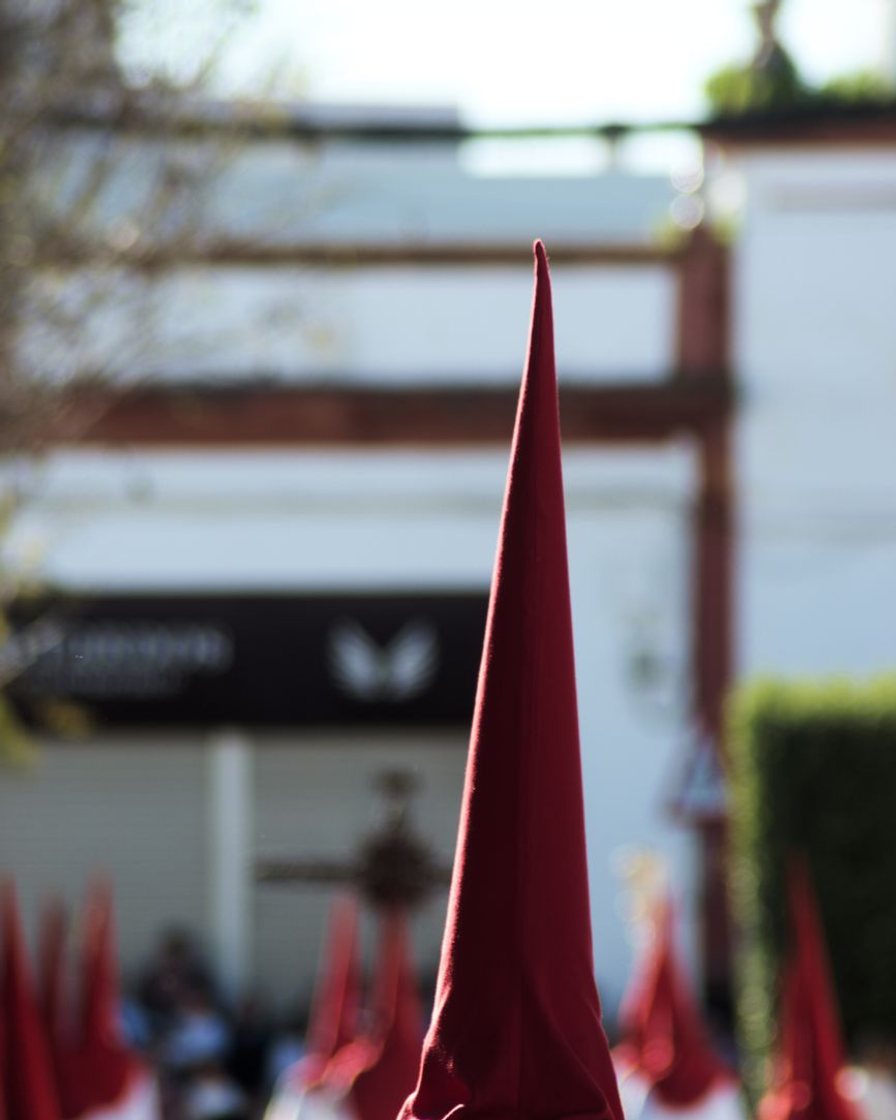
- A compulsory official route. The 71 brotherhoods of 2026 all pass along the same stretch, the Carrera Oficial, from La Campana to the cathedral, between 16:30 and 22:30. That concentrates the crowds and makes it possible to sell chairs.
- La Madrugá. On the night of Thursday 2 to Friday 3 April 2026, the most famous brotherhoods go out at night, with departures between 0:00 and 3:00 and returns between 7:00 and 13:00. A whole night of processions on that scale does not exist in other Andalusian cities.
- A Council that sets every timetable by decree and publishes an official schedule to the minute. In 2026, 46 brotherhoods submitted changes to their timetable or route.
- A crowd-management system with 25 cameras in the centre, GPS tracking of the brotherhoods and, from 2026, a crowd density traffic light announced by the council.
In 2025 the city put more than 130 processions over nine days on the streets. In 2023 the Council counted 57,539 nazarenos on the Carrera Oficial and 61,587 people in the processions. The sources offer no comparison in figures with Málaga, Córdoba or Jerez, and this page does not invent one either.
What is free and what do you pay for?
Watching the processions in the street is free throughout the city, except on the Carrera Oficial, where the pavements are taken up by paid chairs and boxes. They are sold by annual season ticket through the Council of Brotherhoods, with priority for those who already had a seat. A foreigner arriving for the first time has, in practice, very little chance of getting one.
The latest official prices reproduced by the press are from 2024: €85.6 for the cheapest chair, between €148.40 and €187.30 in La Campana, between €708.90 and €962.10 for a box. For 2026 no table has been published. The details are in the general guide.
Everything else costs what it always does, with one caveat: monuments change their hours without notice because of the processions. The cathedral, the Giralda and the Alcázar need booking in advance that week. The what-to-see guide sorts out what is worth it and what is not.
If you do not speak Spanish, a guided tour solves two problems at once: understanding the brotherhood vocabulary (nazareno, costalero, palio, levantá) and knowing where to stand. There are tours in several languages, including English, and the city's full range can be compared in one place.
See activities and guided tours in Seville →Affiliate link: booking through it helps keep this guide going, and costs you nothing extra.How do you get there, and how do you get around that week?
San Pablo airport is between 8 and 10 km from the centre. The EA bus line takes about 35 minutes to Plaza de Armas and cost €6 in 2025; a taxi takes 15 to 20 minutes and costs about €22 at the standard 2024 fare, with a Holy Week supplement.
The details, including the fares that contradict each other, are in the guide to getting to Seville.
A flight from London, Paris or Brussels takes 2 to 3 hours; from Madrid or Barcelona, 1 h 15 to 1 h 30. If you fly into Madrid instead, the AVE high-speed train takes between 2 h 30 and 3 h to Santa Justa.
In the city, the old town is closed to traffic between 10:00 and 2:00 the following morning and the metro runs longer hours: 6:30 to 2:00 from Holy Monday to Holy Wednesday, and a non-stop service from 7:30 on Maundy Thursday, and on Good Friday until 2:00. If you come by car, the park-and-ride car parks are the only sensible option.
When is it least crowded?
It is never quiet. In 2024 the council cameras counted more than 270,000 people in the centre on Holy Tuesday, the busiest day of that edition. The order changes every edition: in 2026 the peaks were La Madrugá, Maundy Thursday and Holy Wednesday, according to eldiario.es.
Local guides agree on three tips. With children, 16:00 to 20:00. To watch without the crush, the eve days in the neighbourhoods and the mornings from Holy Monday to Holy Wednesday. For the full intensity, La Madrugá, knowing that the streets of the centre become impassable and that in 2026 some 300 folding stools were confiscated for safety reasons.
None of these recommendations comes from an official hourly curve: there is none. The council publishes totals by day and by mode of transport, never by time slot or by street.
Figures nobody publishes
- Consolidated visitor figures for Holy Week in Seville: the regional government gives 1.02 million visitors, 22.3% more than in 2024 for the whole of Andalusia in 2025, with no breakdown by city.
- The economic impact with an up-to-date method: the council's figure of around 400 million euros, 1.3% of local GDP has no published report behind it.
- Chair prices and the sales system for 2026.
- TV coverage, year by year.
To plan the rest of your trip, the three-day itinerary explains what to sacrifice when the processions take up the afternoons, and the Seville map gives the real distances between districts.
If the processions are not the reason for your trip, changing week changes the budget. Outside the peaks, a guesthouse costs between €45 and €75 a night and a three-star between €90 and €150 a night, according to 2026 guides. The same room in Holy Week costs several times more, and the local press documents just how much.
Compare places to stay in Seville by date →Affiliate link: booking through it helps keep this guide going, and costs you nothing extra.Sources
- Seville City Council: Holy Week 2026 page, GPS and crowd density tools; reviews of 2023, 2024 and 2026.
- Consejo General de Hermandades y Cofradías: Official Holy Week schedule (Nómina Oficial) 2026 and 2025.
- Visita Sevilla: Holy Week 2026 PDF and Holy Week 2025 PDF.
- El País (27 March 2026), Idealista (17 March 2026), El Mundo (27 March 2026): dates, times and number of brotherhoods.
- Cadena SER: 46 brotherhoods with changes in 2026 (15 March 2026).
- Europa Press: hotel occupancy and visitors in Andalusia, Holy Week 2025 (22 April 2025).
- okdiario: chair and box prices 2024; metro hours during Holy Week 2026 (26 March 2026).
- 20minutos: 2024 crowd review. eldiario.es: 2026 peaks and confiscated stools.
- Spain.info, Travelling to Live, Stay in Seville: airport, EA line and taxi.
- La Línea Gusta: number of processions in 2025. Viva Sevilla: 2023 nazareno count.
- Semana-santa.org: liturgical calendar. Viajes Santamona: 2027 forecast, non-institutional.
Dates and prices carry their year and are updated from the site's fact table. When the information does not exist, the page says so instead of filling the gap.
Frequently asked questions
When is Holy Week in Seville, Spain, in 2026?
Why is Holy Week in Seville different from the rest of Spain?
Is it free to watch Holy Week in Seville?
How do you get from Seville airport to the centre during Holy Week?
Rocío Delgado
Rocío grew up in the San Lorenzo neighbourhood and follows Holy Week from the madrugá, not from the stands. She knows the corners where you can watch a paso go by without waiting three hours, and the streets that close without warning. She never recommends a spot she has not stood in herself.