Luggage storage, toilets and drinking water in Seville
Santa Justa station no longer has left luggage, nor does the airport, and the city publishes no map of public toilets. Where to leave your bags, where to drink and what to do in the middle of August.
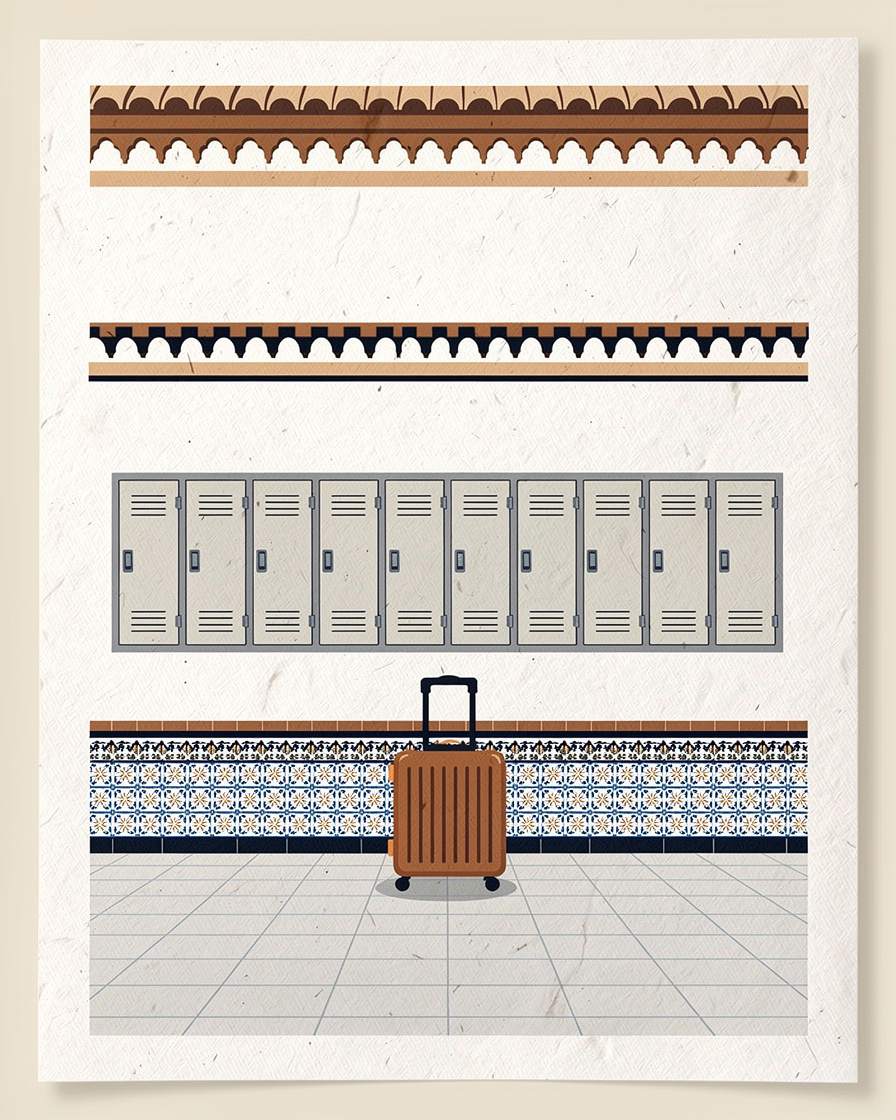
These are the three questions nobody puts on the cover of a guidebook and everybody ends up searching for on day one: where do I leave my suitcase, where is there a toilet, and can I drink the tap water?
All three have an answer in Seville, and two of them come with a surprise. The station's left-luggage office no longer exists, and the city publishes no inventory of permanent public toilets.
Santa Justa's left-luggage office no longer exists
It is the fact that wrecks the most trips, because almost every guide still takes it for granted. Santa Justa station has no official left-luggage office in operation: it closed after the pandemic and never reopened.
This is confirmed independently by Ouigo, which says so on its own information page, and by two specialist outlets that documented the closure in 2025. Adif's pages returned an access error when we tried to check directly, so we flag it.
The airport does not have one either. The service does not appear on Aena's list, and an airport information website says so plainly, recommending the storage points in the centre instead. If you land with a few hours to kill before check-in, plan for that.
So where can you leave your luggage?
Two options remain, and it is worth knowing both because they do not serve the same purpose.
- The Plaza de Armas bus station has automatic lockers, confirmed by the municipal tourist board. It opens from 5:30 to 1:30 Sunday to Thursday, and 24 hours on Fridays and Saturdays.
- The Prado de San Sebastián station also has lockers according to third-party sources, but the official tourist listing does not mention them, and the prices going around contradict each other, between €2 and €3.50 for twenty-four hours.
- Luggage storage networks in shops (Bounce, Radical Storage, LuggageHero, Nannybag) cover the centre with dozens of points and charge from €1.60 to €6.90 a day depending on the network and the size of the bag.
We have to be frank: the price of the Plaza de Armas lockers is not published in any official source, and its own website could not be reached when we checked. We give the opening hours because they are confirmed, and we do not invent the rate.
The solution that almost always works out cheapest: book accommodation that keeps your luggage before check-in and after check-out. It is a free service in most hotels and in quite a few flats with a reception, and it saves the €5 to €15 of a storage locker on your arrival or departure day.
Find accommodation in Seville on Booking.com →Affiliate link: booking through it helps keep this guide going, and costs you nothing extra.Public toilets: what exists and what is not published
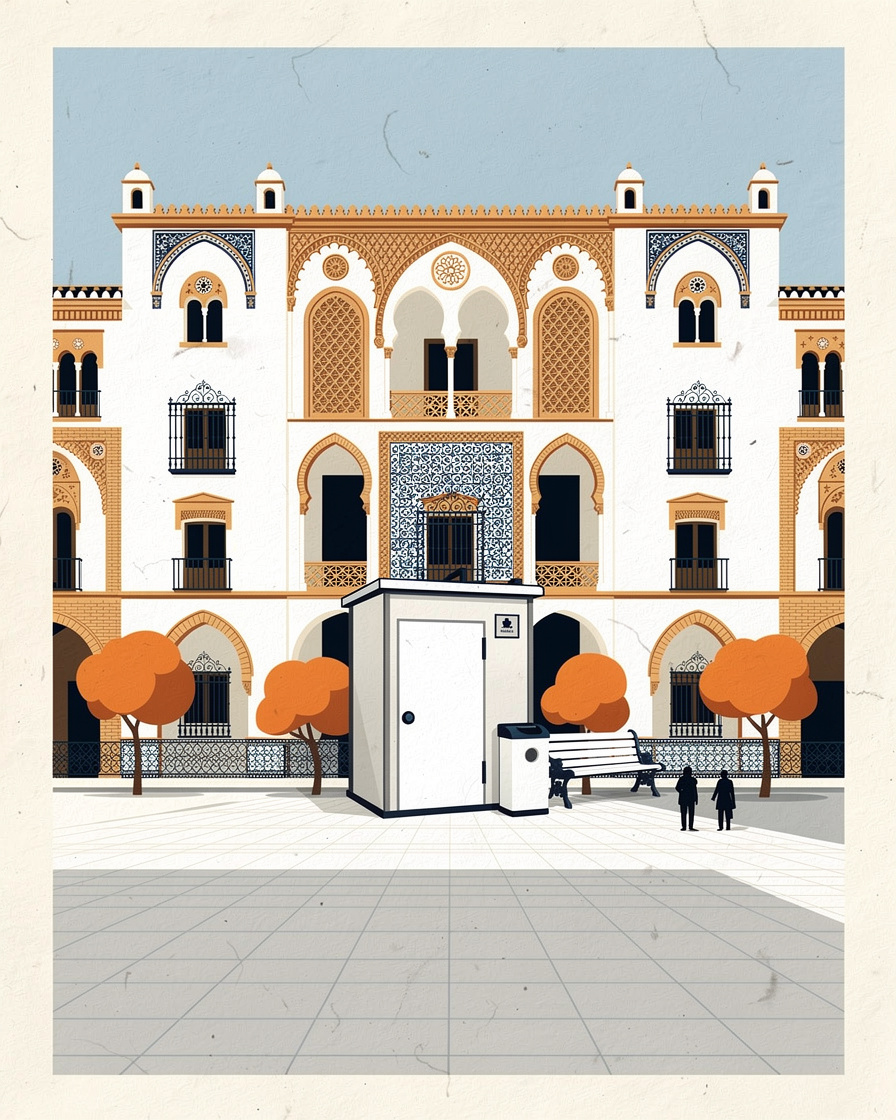
Here the honest answer is an awkward one. We have found no municipal inventory of permanent public toilets in Seville: the city's open data portal does not publish that dataset.
It is not a Spanish inevitability. Vitoria-Gasteiz, for example, publishes its list of public toilets as open data and updated it in 2025. In Seville, that file simply does not exist.
There is a telling clue about the permanent infrastructure. For the 2022 UEFA final, the council installed 110 urinals at ten locations in the centre, and the press release noted that Lipasam was taking on those facilities "for the first time".
During Holy Week there is a set-up. The 2023 one, the last with a public breakdown, announced 20 chemical toilets and six accessible modules of six units each, free, open from an hour before the first brotherhood passes along the Carrera Oficial until an hour after the last.
One detail is worth adding that is rarely mentioned: the breakdown by location on that same council page adds up to 25, not 20. The inconsistency is in the source, not in our count, and we would rather flag it than pick a figure at random.
The tap water is drinkable, and the numbers say so
This really is good news, with solid documentary backing. EMASESA's July 2025 quality bulletin gives 0 cfu per 100 mL in 64 analyses for E. coli, enterococci and coliforms.
- Hardness: 114.9 mg/L of calcium carbonate, around 11.5 French degrees, moderately hard water, well below the regulatory limit.
- Free residual chlorine: 0.5 mg/L, against a limit of 1.0.
- Nitrates: 2.8 mg/L, against a limit of 50.
- Turbidity: below 0.30 NTU, against a limit of 4.
Every chemical parameter, including pesticides, heavy metals and perfluorinated compounds, is below the limits of Royal Decree 3/2023. EMASESA reports 372,877 analyses on 13,083 samples in 2025, in accredited laboratories.
In practice: carrying a bottle and refilling it is perfectly reasonable in Seville, and in summer it is also the most sensible decision of the day.
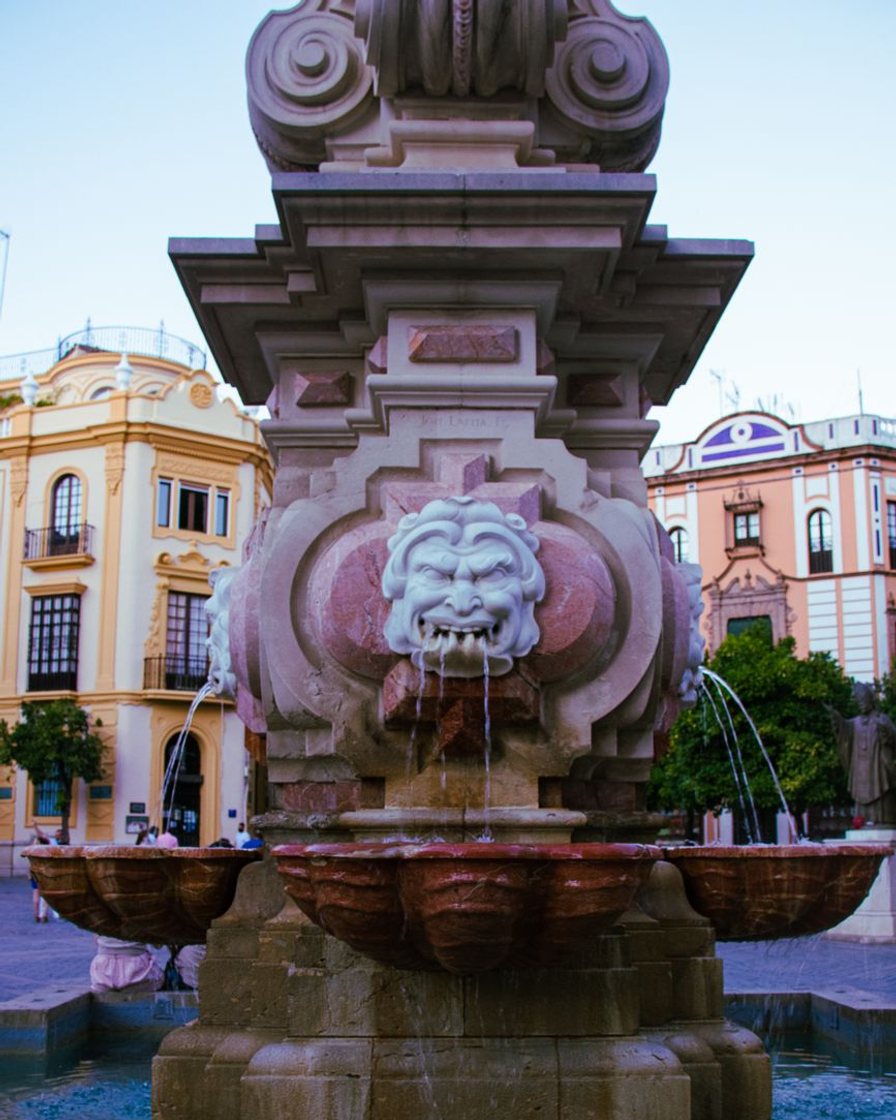
Street fountains, and their uneven geography
The city has 168 public fountains, 103 of them outside parks and green spaces, according to a 2025 analysis that cross-referenced data from EMASESA, the INE (Spain's statistics institute) and a report by the APDHA human rights association.
They are not evenly spread, and that is the interesting part. The ratio runs from 1,780 residents per fountain in the central districts to 22,728 in the outlying ones, with whole districts that have none.
For visitors, the consequence is a good one: the old town, Los Remedios and Nervión are among the best served. EMASESA publishes an interactive map of public fountains, although it does not give a total on that page.
We have found no rule about switching drinking fountains off in winter. The only restriction we located is a 2024 drought order, which limited their use to drinking and banned recreational use.
In Holy Week, these services become critical. With the centre closed for hours, wandering off to find a toilet or a locker means losing your spot and not being able to get back. Sleeping inside the closed area solves luggage, toilet and water bottle in one go, and it is what gets booked furthest ahead.
See places to stay for the peak dates →Affiliate link: booking through it helps keep this guide going, and costs you nothing extra.The heat, the public service you need most in July
The average maximum temperature in Seville is 36.0 °C in July and 35.5 °C in August, according to AEMET's climate normals for the airport weather station. The all-time record is 46.6 °C on 23 July 1995.
The figures of 49.8 to 51 °C attributed to 1881 that circulate online are not reliable, according to an independent fact-check. And on 3 September 2026, Tablada reached 45.1 °C, a record for September.
Seville was the first city in the world to name and rank its heatwaves, under the ProMETEO programme: the first one was called Zoe, in July 2022.
The council's 2025 heat contingency plan opened five air-conditioned sports halls open from 12:00 to 21:00 and eleven water distribution points, plus five municipal swimming pools. In 2026 the campaign was extended to weekends in June.
Wi-Fi, pharmacies, emergencies and lost property
- Free Wi-Fi across the whole TUSSAM bus fleet and on the Metrocentro tram since 2019, and municipal Wi-Fi in Plaza de América in María Luisa Park, with twelve access points, since 2022.
- Duty pharmacies: the official finder of the Seville College of Pharmacists, with the pharmacy on duty that day.
- Emergencies: 112 general, 092 Local Police, 091 National Police, 061 Andalusian health emergencies. For non-urgent health information, Salud Responde.
- Non-urgent council information: the council's 010 line.
- Lost property: municipal office at Calle Otto Engelhardt 3, open 8:30 to 14:15, Monday to Friday, with ID or a written authorisation.
How long an item takes to reach that office varies a lot depending on where it was lost: around fifteen days if it turns up in the street, one to three days from a TUSSAM bus, seven from the metro, three from a taxi and up to three months from the airport.
On USB or electric charging points in parks and squares, the council has published nothing. Only commercial offers of street furniture turn up, with no record of a municipal roll-out.
With these services sorted, what remains is planning your days: which visits are worth it and what they cost, how to get around and at what price, the map of the centre and its districts and where to stay, district by district.
Sources
- EMASESA: bulletin "Average values in the distribution network", July 2025, published by the Quality Division; water quality page; map of public fountains.
- El Salto Diario: analysis of the distribution of public fountains (October 2025), based on EMASESA, the INE and a 2024 APDHA report.
- Seville City Council, sevilla.org: other Holy Week 2023 services; Lipasam special cleaning plan for the UEFA final (2022); drought alert declaration (2024); heat contingency plan (August 2025); 2026 swimming pool campaign; TUSSAM Wi-Fi (2019) and WiFi4EU (2022); municipal lost property office; 010 line.
- Ouigo, El Giroscopo and 21noticias: closure of the Santa Justa left-luggage office (2025).
- Aena and Aeropuerto-sevilla.com: no left luggage at the airport.
- Visita Sevilla, Movelia and Owaytours: lockers and opening hours at the Plaza de Armas station.
- Bounce, Radical Storage, LuggageHero and Nannybag: shop-based luggage storage rates, consulted in September 2026.
- AEMET: 1981-2010 climate normals for the Sevilla Aeropuerto station. Maldita.es: fact-check of the supposed 1881 record.
- University of Seville: ProMETEO heatwave naming programme.
- Seville College of Pharmacists and Junta de Andalucía: duty pharmacies and emergency numbers.
Several figures on this page come from council pages that returned an access error when we checked them again. Where that happened, the text says so rather than presenting them as verified.
Frequently asked questions
Is there left luggage at Santa Justa station in Seville?
Can you drink the tap water in Seville?
How many drinking water fountains are there in Seville?
Where are the public toilets in Seville?
Marta Bermúdez
Marta spent five years on the front desk of a hotel in the centre, answering the same questions about parking and the metro every day. She writes the pages she would have liked to hand to her guests. She checks every fare on the operator's website, never in a guidebook.