Seville Holy Week 2026 procession routes: the Carrera Oficial and the routes day by day
Every brotherhood shares one stretch and each has its own route. This guide explains how to read the official 2026 itinerary, when the processions pass along the Carrera Oficial, where to stand depending on what you want to see and what the itineraries leave out.
The itinerary of Seville's Holy Week is not a map: it is 71 brotherhoods, with seventy-one different routes that converge on one shared stretch. People looking for "the itinerary" usually want two things: to understand that shared stretch, and to know where a particular brotherhood will pass at a particular time.
This page explains the first in detail and shows where to find the second, because each brotherhood's street-by-street route lives in the official PDFs, not on a web page. It also says which earlier editions can still be consulted and which can no longer be found.
What is the Carrera Oficial and where does it go?
It is the compulsory stretch that every brotherhood walks to make its station of penance at the cathedral. Five points, always in the same order: Plaza de la Campana, Calle Sierpes, Plaza de San Francisco, Avenida de la Constitución and the cathedral, through the San Miguel door.
The passage along the Carrera Oficial is concentrated between 16:30 and 22:30, according to El País, based on the 2026 schedule. Before that window, the brotherhoods are in their neighbourhoods on the way in; afterwards, in their neighbourhoods on the way back. That is where each one's own route matters.
The official 2026 schedule, approved by decree on 15 March 2026 and last updated on 9 April 2026, gives for each brotherhood the time it leaves, the time it passes La Campana, the time it enters the cathedral and the time it returns to its church. In 2026, 46 brotherhoods submitted changes to their timetable or route compared with 2025.
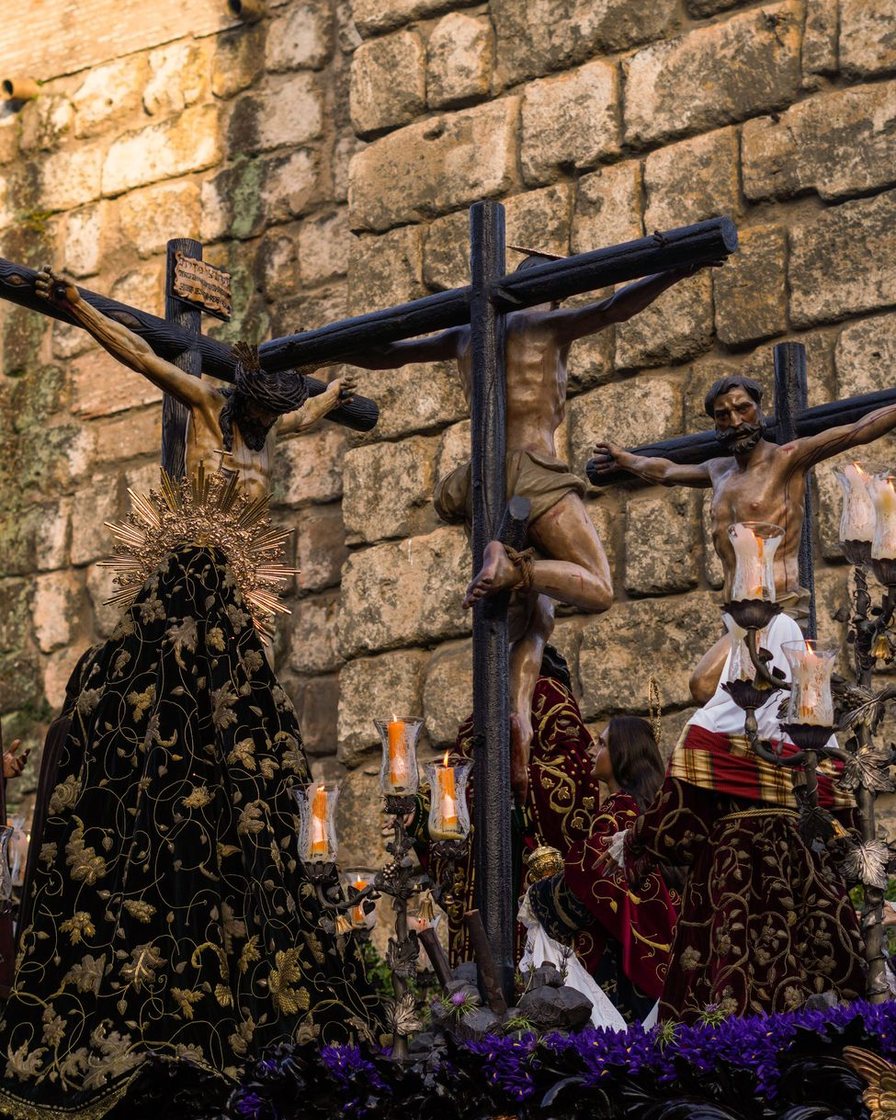
Example routes with times, 2026 edition
Five brotherhoods are enough to see the pattern. The times are those published by El País on 27 March 2026 from the official schedule, and brotherhoods on the big days can spend 8 to 10 hours in the street.
| Brotherhood | Day | 2026 times |
|---|---|---|
| La Borriquita | Palm Sunday | Leaving at 14:15, the Campana at 15:35, the Cathedral at 17:00 and the palio back in at 22:00 |
| La Cena | Palm Sunday | Leaving at 14:00, the Campana at 15:50, the Cathedral at 17:20 and back in between 21:15 and 22:00 |
| El Cerro | Holy Tuesday | Leaving at 11:40, the Campana at 16:40, the Cathedral at 18:05 and back in between 1:00 and 2:00 |
| El Sol | Holy Saturday | Leaving at 12:45, the Campana at 17:15, the Cathedral at 18:40 and the palio back in at 22:55 |
| La Resurrección | Easter Sunday | Leaving at 8:30, the Campana at 10:55, the Cathedral at 12:25 and the palio back in at 16:30 |
One contradiction worth knowing about: for La Borriquita, 20minutos publishes leaving at 14:35 and back in at 18:25, almost four hours' difference in the return time compared with El País. When two newspapers disagree, the reference is the Council's PDF, not this page.
La Madrugá turns the clock upside down: departures between 0:00 and 3:00 and returns between 7:00 and 13:00 for the brotherhoods of the night of Maundy Thursday into Good Friday. Like every day, it has its own route PDF.
The itinerary decides where you should sleep, not the other way round. A Triana brotherhood returns to its church after midnight across the bridge; a brotherhood from the centre goes back in at 22:00, three streets from La Campana. Staying on the return route you want to see saves you the one hour when the centre is impassable.
See places to stay for the Holy Week dates →Affiliate link: booking through it helps keep this guide going, and costs you nothing extra.Where are the full routes, street by street?
In four places, and none of them is a convenient web page. The Consejo General de Hermandades publishes the official schedule as a PDF and a timetables and routes section. Visita Sevilla, the municipal tourism portal, publishes a PDF with a grid for each day and maps. The Semana-santa.org portal publishes one PDF per day: Holy Monday, Holy Tuesday, Holy Wednesday, Maundy Thursday, La Madrugá.
The press does the same more conveniently: ABC offered a 2026 programme as a PDF and Diario de Sevilla a digital programme, both at the end of March 2026. The programme PDF page explains which one to download depending on what you need it for.
Each day's PDF gives, line by line, each brotherhood's successive streets and the time it passes the fixed points: for example "Palos (21:40)" or "Entrada (23:20)", entrada meaning its return to the church. It is the only format in which the full itinerary exists, and it is in Spanish only. The timetable guide sums up the time windows for each day.
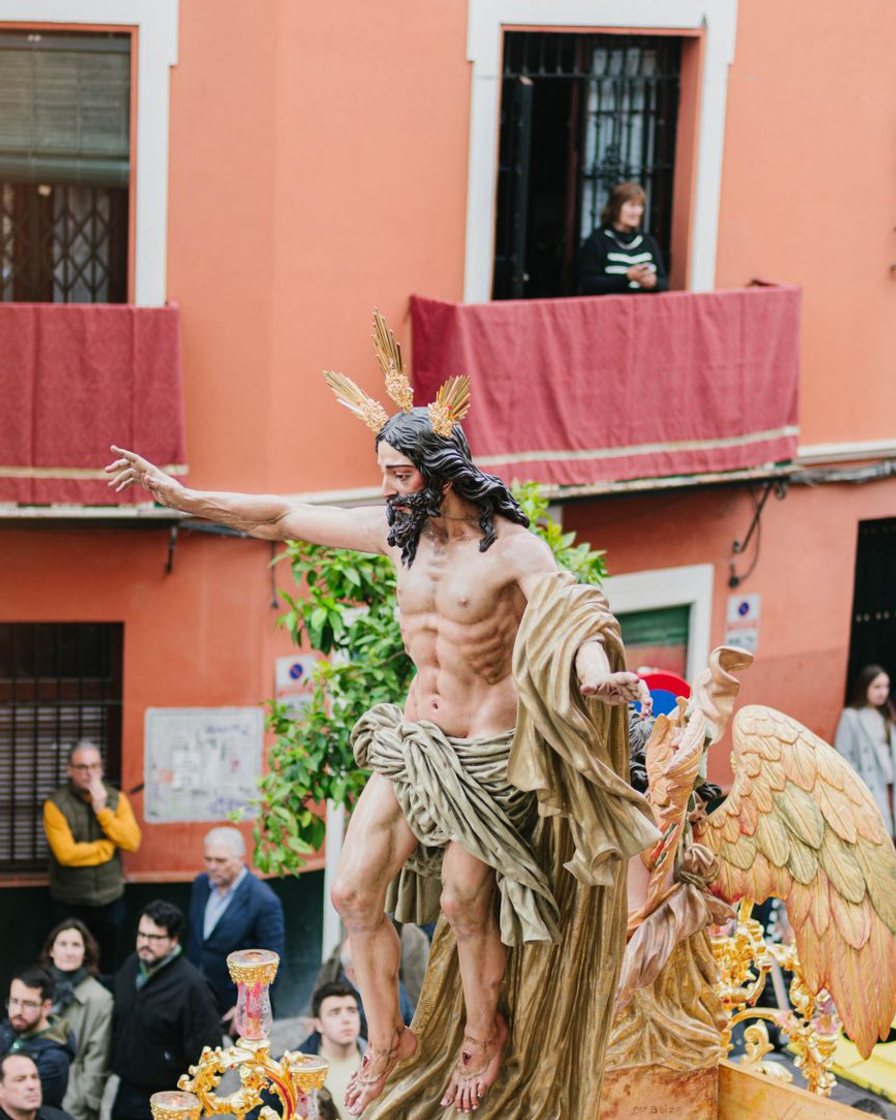
Where should you stand, depending on what you want to see?
The Carrera Oficial is the most crowded spot and has the worst view if you have no chair: the pavements of Sierpes and the Avenida are taken up by paid seats. Guides written by locals agree on three better alternatives, all free.
- The departure from and return to the church, in the brotherhood's own neighbourhood: this is where you see the levantá (the float being lifted) and the showers of petals, and where the crowd is local.
- The narrow streets of the return route, where the float brushes the balconies and you can hear the capataz (the foreman directing the bearers). Postigo del Aceite, Plaza del Salvador and Cuesta del Rosario are mentioned in several guides.
- The bridges to Triana for the brotherhoods from across the river, bearing in mind that they are also a crush point.
To avoid at peak times: Plaza del Altozano, the junction of Reyes Católicos and La Magdalena and the immediate surroundings of the cathedral, according to Diario de Sevilla's crowd guide. The rule every source repeats: do not follow a brotherhood through the crowd and do not try to cut across a procession.
La Campana is closed to traffic from Tuesday 24 March at 10:00 until Easter Sunday in 2026, and the official route closes two hours before the brotherhood passes. The Seville map helps you place the neighbourhoods in relation to the Carrera Oficial.
A guide who knows the brotherhoods knows which corner to watch the levantá from and what time to be there. It is the difference between reading a PDF and understanding it. Tours on the brotherhood theme can be compared with the city's other activities in a single catalogue.
See guided tours in Seville →Affiliate link: booking through it helps keep this guide going, and costs you nothing extra.
Can you still consult the 2025, 2024 and 2023 routes?
With mixed success. Those for 2025, from 13 to 20 April 2025, are still available: the Council's official schedule and the council PDF of maps, timetables and planned routes, which included that year's schedule changes.
Those for 2024, from 24 to 31 March 2024, survive mainly in the press: El Confidencial and 20minutos published the full programme, with more than 70 brotherhoods according to El Confidencial. Those articles have been updated in 2025 and 2026, which makes it hard to know which version of the timetable you are reading.
For 2023, from 2 to 9 April 2023, no comparable route PDF turns up in the sources consulted. It existed, but it is not linked from the sites that now publish those for 2024 to 2026. Anyone who wants to reconstruct a brotherhood's 2023 route will have to ask the brotherhood itself.
What the itineraries do not tell you
- Crowd levels by street and by hour. The PDFs give passing times, never crowd density. The recommendations on this page are deductions, not measurements.
- The price of Carrera Oficial chairs in 2026: the route documents describe the route and say nothing about the price.
- Which streets are closed to pedestrians and for how long. Only the road closures exist, in the transport guide.
- Processions cancelled or shortened because of rain, which are announced in real time on each brotherhood's radio and social media, with no record kept afterwards.
The routes are the best-documented part of Seville's whole Holy Week. Almost everything else, starting with what it costs, is in the general guide.
Outside Holy Week, the brotherhoods' routes are the best map of the historic centre. The streets the floats pass along are the ones worth walking any other week of the year, with far fewer people and at mid-season prices.
Compare places to stay in central Seville →Affiliate link: booking through it helps keep this guide going, and costs you nothing extra.Sources
- Consejo General de Hermandades y Cofradías: Official Holy Week 2026 schedule (decree of 15 March 2026, PDF updated on 9 April 2026); Timetables and Routes section; Official 2025 schedule.
- El País: Seville Holy Week 2026 programme, dates, times and routes (27 March 2026).
- 20minutos: Seville Holy Week 2026 guide; full 2024 programme and Maundy Thursday 2024.
- El Confidencial: full programme of Holy Week 2024 (28 March 2024).
- Visita Sevilla: Holy Week 2026 PDF and 2025 PDF of maps, timetables and planned routes.
- Semana-santa.org: official 2026 itinerary and PDF by day (Holy Monday, Tuesday, Wednesday, Maundy Thursday and La Madrugá).
- Diario de Sevilla: official 2026 routes and times; areas to avoid in the crowds.
- Cadena SER: 46 brotherhoods with changes (15 March 2026). El Mundo: 71 brotherhoods in 2026.
- Seville City Council: Holy Week 2026 special mobility plan.
- Nomado Travel, Doyouspain, Diario de un Mentiroso, Miruta: where to stand and what to avoid.
The times quoted are those published by the press from the official schedule and carry their year. When two outlets disagree, the page says so and refers you to the Council's PDF.
Frequently asked questions
What is the route of the Carrera Oficial in Seville's Holy Week?
Where is the full Seville Holy Week 2026 itinerary published?
What time does La Borriquita leave in 2026?
How long does a brotherhood's procession last in Seville?
Rocío Delgado
Rocío grew up in the San Lorenzo neighbourhood and follows Holy Week from the madrugá, not from the stands. She knows the corners where you can watch a paso go by without waiting three hours, and the streets that close without warning. She never recommends a spot she has not stood in herself.