3 days in Seville: an itinerary with actual timings, and what to drop with 2 days or add with 4
Three-day itineraries all look alike and fail for the same reason: they cram the Alcázar, the Cathedral and Plaza de España into one day. This one spreads the big three over three mornings, puts numbers on queueing time and explains how to rearrange it if processions are on.
Three days is the right length for Seville: enough to see the three big monuments without rushing and two neighbourhoods at an easy pace. The condition is not to do what most published itineraries do, which is to pile the Alcázar, the Cathedral and Plaza de España into the first day.
This itinerary gives each morning one big monument and uses the afternoons for neighbourhoods, palaces or processions. The timings include queues and walking, and come from the guides that bother to put numbers on them; where nobody does, it says so.
How long does each visit really take?
Guides publish the time spent inside the monument: 1 h 30 to 2 h for the Alcázar, 1 h 30 to 2 h 30 for the Cathedral with the Giralda. None publishes queueing time, and there is no public database of waits by time of day.
With the queue, the security check and leaving through the gardens, the Alcázar block stretches to 2 h 30 to 3 h 30 on a busy day, and the Cathedral to 2 h 30 to 3 h 30. That is why the morning slot the guides recommend, 9:00 to 13:00, in practice means at least 3 h to 3 h 30 per block.
Plaza de España and María Luisa Park take 1 h 30 to 2 h 30 including the walk, Santa Cruz 1 h 30 to 2 h 30 and Triana 1 h 30 to 3 h with the bridge, the market and tapas. Entry prices with their year are in the guide to things to do in Seville.
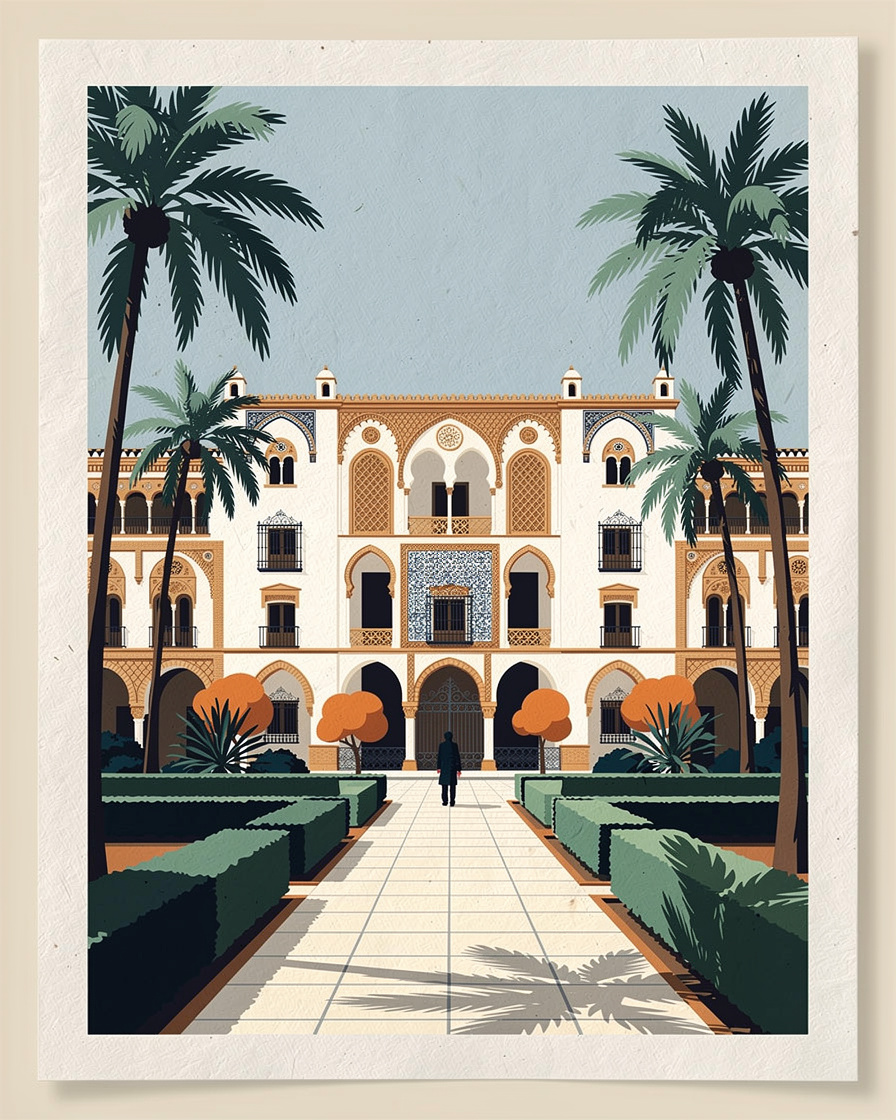
Day 1: the Cathedral, the Giralda and Santa Cruz
Morning. The Cathedral and the Giralda at opening time, with a pre-booked ticket. This is the block that suffers most from the mid-morning ticket queue, and climbing the Giralda in the heat is worse than doing it early.
Afternoon. Santa Cruz, 15 to 20 minutes on foot, stopping in Plaza Virgen de los Reyes. Alleys, patios, Plaza de Doña Elvira, and the Casa de Pilatos if you still have the energy. Dinner in the neighbourhood or, better, outside it.
Day 2: the Alcázar and the shopping streets
Morning. The Alcázar in the first slot of the day, booked from several days to a week ahead in high season. The gardens are half the visit and the part where the crowd thins out. It is less than 300 metres, 5 to 10 minutes from the Cathedral, which tempts people to combine them: the classic mistake.
Afternoon. The Archivo de Indias, which is free, then the centre heading north: the church of El Salvador, Plaza del Salvador, and Las Setas, 20 to 30 minutes on foot from the Cathedral, for sunset. Las Setas is the first thing to drop if the day runs long.
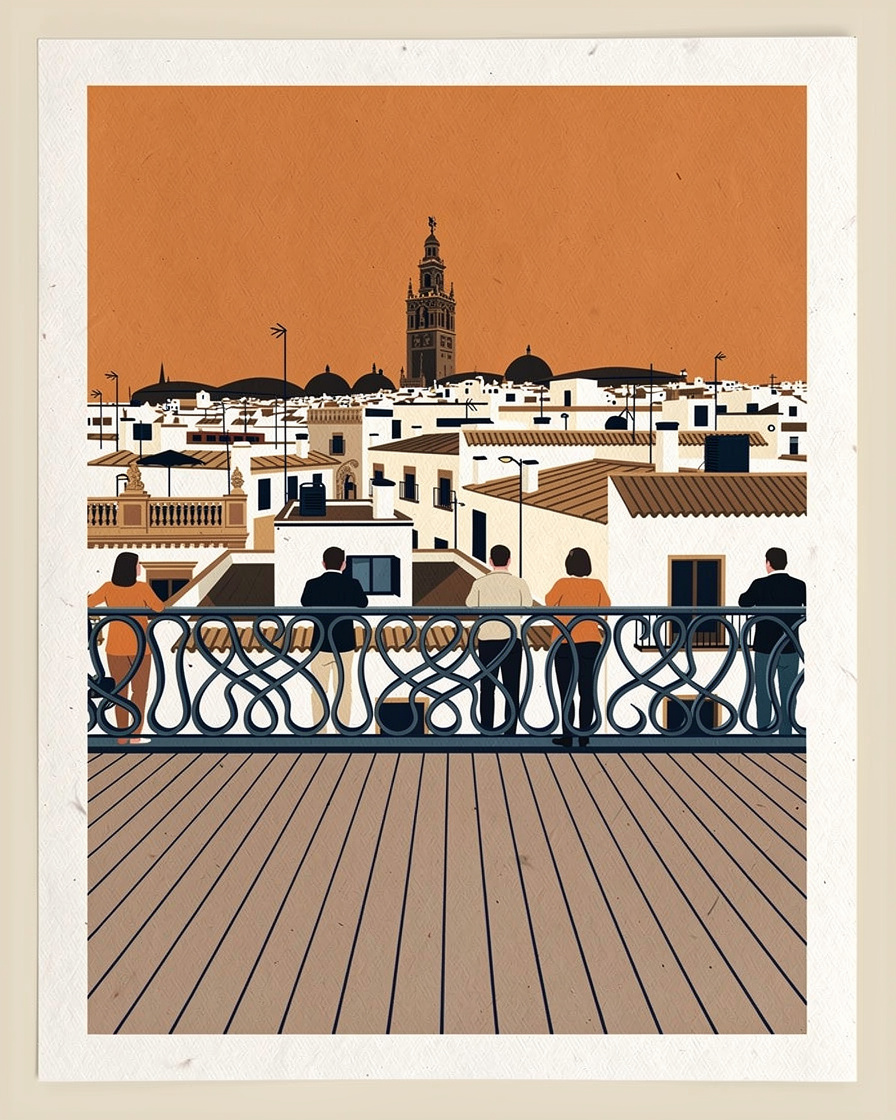
With one big monument per morning, the neighbourhood of your hotel decides what time you get in. Staying ten minutes' walk from the Alcázar lets you be at the gate when it opens and go back for a rest at midday; a hotel in Nervión means getting up twice as early. Comparing by minutes on foot, not by star rating, is what changes the itinerary.
Compare places to stay in Seville by neighbourhood →Affiliate link: booking through it helps keep this guide going, and costs you nothing extra.Day 3: Plaza de España, the river and Triana
Morning. Plaza de España from Santa Cruz, 20 to 30 minutes past the old Tobacco Factory and the Puerta de Jerez. Then María Luisa Park and its two museums, Archaeology and Popular Arts and Customs, which close on Mondays.
Afternoon. Down to the river: the Torre del Oro 20 to 25 minutes from the square, the riverside walk and the Triana bridge 10 to 20 minutes further on. Triana market, Calle Betis and the Centro Cerámica, with dinner in the neighbourhood.
All told, a keen visitor walks 8 to 12 km, that is 2 h 30 to 4 h of walking each day. That is not a published figure: it comes from adding up the stretches the guides describe, and it explains the fatigue no itinerary mentions. The map of Seville places each stretch.
What closes on which day?
The most common mistake in badly built itineraries is scheduling a museum on a Monday. The Fine Arts Museum, the Archaeological Museum and the Museum of Popular Arts and Customs follow the pattern of public museums: closed on Mondays, with shorter hours on Sundays and public holidays. No three-day guide builds this in, and plenty of travellers find out at the door.
The Cathedral and the Alcázar have partial closures for religious services, with no calendar published in the itineraries, which refer you to the official websites. During Holy Week the restrictions are greater and are not announced in advance either.
Rule of thumb: museums between Tuesday and Saturday; Mondays for neighbourhoods, private palaces and the Alcázar, which also has a free slot on Mondays late in the afternoon, often from 18:00 to 19:30, under conditions the sources never quite spell out.
What should you drop with 2 days, and add with 4?
- With 2 days: keep the Alcázar, the Cathedral and Giralda, Santa Cruz, Plaza de España and Triana. Drop the museums, the secondary palaces (Pilatos, Dueñas, Lebrija) and Las Setas. The first day will be very full, and you have to accept that.
- With 3 days: the itinerary above. The afternoons can take a palace or a museum, or the processions if it is Holy Week.
- With 4 days: either the trip to Itálica, the Roman site, which needs a bus or a car and which no itinerary details; or a day of palaces and the Macarena: Casa de Pilatos, Dueñas, the Fine Arts Museum and the basilica. It is the only format with room for rain or the unexpected.
The guides that set priorities agree on the order of sacrifice: the secondary palaces first, then Itálica, and never the big three or Triana. For a single day, the one-day itinerary applies the same logic to the extreme.
How does the itinerary change during Holy Week?
The map changes. The Carrera Oficial, from the Campana to the Cathedral, is taken up between 16:30 and 22:30 and the centre seizes up from 19:00 onwards.
The walks between the Alcázar, the Cathedral, Plaza Nueva and Calle Sierpes get longer or are cut off, and no source measures it: this guide estimates between 30% and 60% of extra time when processions are passing, and flags it as an estimate.
The rearrangement that works: monuments in the morning, before 15:00, with booked tickets; processions in the afternoon and at night, taking your spot early; and giving up on crossing the centre between two visits from mid-afternoon. One of the three days goes entirely to the brotherhoods, and it is worth it.
The old town is closed to traffic between 10:00 and 2:00 the following morning, so a car has no place in the plan. The Holy Week guide gives the least crowded days, and the timetable guide the time slots for each day.
During Holy Week the itinerary is built around the hotel, because the centre becomes an island from 19:00. Staying inside the perimeter lets you watch a brotherhood return to its church at midnight and then go up to your room; staying outside forces a choice between the procession and the last metro. Rooms inside sell out months ahead.
See places to stay for the Holy Week dates →Affiliate link: booking through it helps keep this guide going, and costs you nothing extra.What has not been published?
- Waiting times by monument, hour and season: only advice along the lines of "book ahead".
- Distances and walking minutes between stops: itineraries publish maps, not figures. The ones on this page are map-based approximations.
- The measured impact of the processions on walking times.
- An overall three-day budget with tickets, transport, meals and booking fees.
- The list of unexpected closures for religious services, filming or restoration.
For transport between neighbourhoods, the guide to getting around Seville says when the bus is worth it over walking.
Sources
- Viajeros Callejeros: Seville in 3 days. Barceló Guía de Turismo: Seville in 3 days. Visita Sevilla: Seville in 3 days PDF, 2024.
- Seville-trip: 3-day itinerary, timings and bookings (2026). Nomado Travel: 3 days in Seville, don't overload the days.
- Wandersmiles, The Diary of a Nomad: Alcázar and Cathedral durations, booking to avoid queues.
- Salir por Sevilla, Yourcocotrip, Lovely Travel Plans, Andelaria: what to drop, Itálica, 2024 ticket prices.
- Andalucía Mía: the 18 must-sees and the park's museums. eldiario.es: 8 essential places in 3 days.
- Viator: 3 days for first-timers, museums closed on Mondays.
- ABC de Sevilla, 20minutos: Holy Week 2024 routes and timetables, occupation of the Carrera Oficial.
- Seville City Council: special Holy Week 2026 traffic plan.
Times with queues and walking minutes are those published by the guides that put numbers on them, and are flagged as estimates where no source measures them.
Frequently asked questions
Are 3 days enough to see Seville?
What should you see in Seville in 2 days?
What can you add to a 4-day Seville itinerary?
What is closed on Mondays in Seville?
Álvaro Pineda
Álvaro worked for seven years as a guide at the Alcázar before he started writing. He walks his itineraries with a stopwatch and cuts whatever does not fit into a real day. He would rather say a monument is not worth it than pad out a list.