Holy Week in Seville: dates, times, figures and how to see it without the crush
Everything about Seville's Holy Week that can be documented with a date and a source: the calendar for five editions, how a day of processions works, what a seat costs and crowd figures that neither the council nor the press can reconcile.
Seville's Holy Week (Semana Santa) is both the city's most regular event and its worst documented. The dates are known years in advance and every brotherhood has its timetable to the minute, but nobody publishes how many people are in a given street at a given time, or what a chair costs in 2026.
This page brings together what is published, with its year and source, and says just as clearly what is not. It is the entry page for the whole topic: the times brotherhood by brotherhood, the programme as a PDF, the poster and the itinerary each have their own guide, linked below.
When is Holy Week in Seville?
The date follows the Easter calendar, so it moves every year within a window running from the third week of March to mid-April. The 2026 edition runs from 29 March to 5 April 2026, from Palm Sunday to Easter Sunday.
The eve days start earlier: on Viernes de Dolores, 27 March, and Sábado de Pasión, 28 March 2026, brotherhoods from outlying neighbourhoods are already out. La Madrugá, the big night, falls on the night of Thursday 2 to Friday 3 April 2026.
- 2023: from 2 to 9 April 2023.
- 2024: from 24 to 31 March 2024.
- 2025: from 13 to 20 April 2025.
- 2026: from 29 March to 5 April 2026.
- 2027: from 21 to 28 March 2027, according to the liturgical calendar. As of September 2026, neither the Council of Brotherhoods nor the city council had published anything for 2027: the only source is a travel blog.
For 2027, rely on the pattern rather than a promise: the same eight days, the same Carrera Oficial, and the official schedule arriving in mid-March. The 2026 schedule was approved by decree on 15 March 2026, two weeks before Palm Sunday.
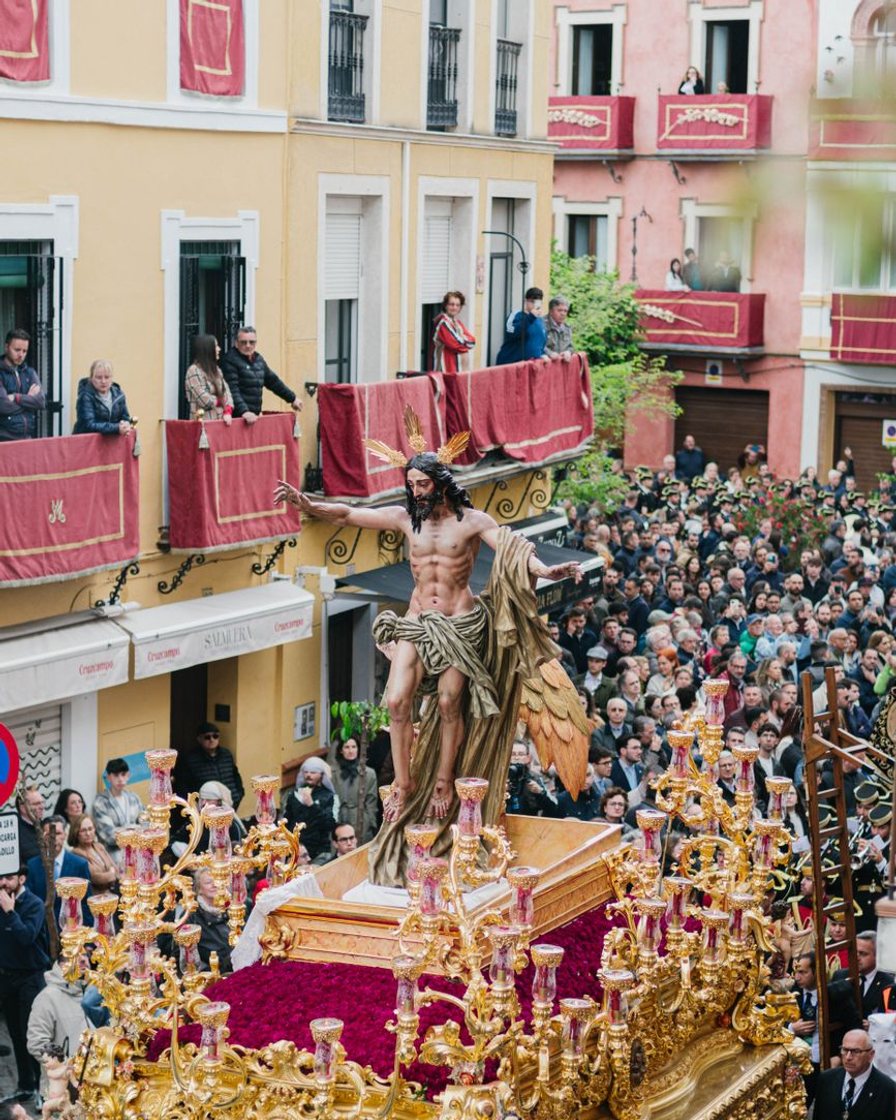
The date is known a year ahead, and that is exactly the problem. Hotels in the centre fill up long before the official schedule comes out, and in 2025 hotel occupancy in Seville reached 83% on average, 87% from Maundy Thursday to Holy Saturday and a peak of 89.2% on Good Friday, according to the regional government. Locking in a cancellable option early is the only lever a traveller has left, especially if you also need to book flights.
See places to stay for the Holy Week dates →Affiliate link: booking through it helps keep this guide going, and costs you nothing extra.How does a day of processions work?
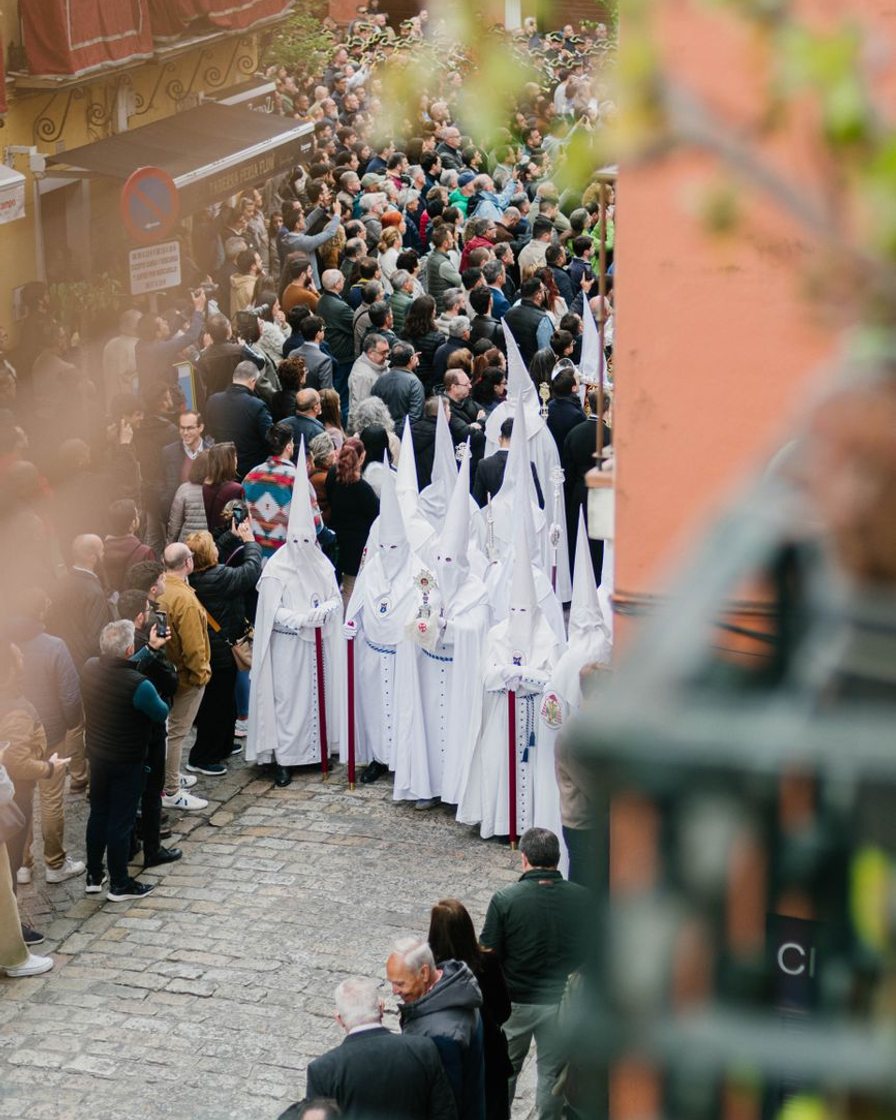
Each brotherhood (hermandad or cofradía) leaves its church, follows its own route, makes its "station of penance" at the cathedral and returns. They all pass through the same shared stretch, the Carrera Oficial: La Campana, Calle Sierpes, Plaza de San Francisco, Avenida de la Constitución and the cathedral.
Departures towards the centre are concentrated between 12:00 and 16:00 and the passage along the Carrera Oficial between 16:30 and 22:30, according to El País, based on the 2026 schedule. Returns run on until after midnight: a brotherhood spends 8 to 10 hours in the street.
In 2026, 71 brotherhoods made their station of penance, according to El Mundo. The figure is not stable across sources: a 2008 study counted 58 brotherhoods in 2007, against 47 in 1999, and travel guides speak of between 70 and 76 brotherhoods. It depends on whether the eve days and some other confraternities are counted.
The detailed timetable, brotherhood by brotherhood, is in the 2026 timetable guide. The routes street by street, in the Holy Week 2026 itinerary. And where to download the official document, on the programme PDF page.
Watching a brotherhood needs no ticket, but understanding what you are seeing does need someone to explain it. The city's guided tours, including those on the brotherhoods, are a sensible way to come to Holy Week with some context, especially the first time.
See guided tours and activities in Seville →Affiliate link: booking through it helps keep this guide going, and costs you nothing extra.Free in the street, paid on the Carrera Oficial
Watching the processions from the pavement is free and needs no booking. The only thing you pay for is a seat on the Carrera Oficial, where the Consejo General de Hermandades y Cofradías sells chairs and boxes by annual season ticket, with priority for previous holders and a waiting list for everyone else.
The only official prices the press has reproduced are from 2024. A chair cost between €148.40 and €187.30 in La Campana, €148.4 on Sierpes, between €116.10 and €152.60 on the Avenida and €85.6 in Plaza Virgen de los Reyes.
A box in Plaza de San Francisco cost between €708.90 and €962.10, and on the Avenida around €881.90.
For 2025 and 2026, none of the sources consulted publishes the table. Nor is the number of chairs published, the date sales open or the share kept for long-standing season ticket holders. It is the biggest gap in the whole of Seville's Holy Week.
Resellers exploit that gap: close to the date, a chair has sold for up to €175 per chair in areas that officially cost less, with mark-ups of between 30 and 70 % above the official price. Many locals do not buy a chair: they pick a street on the return route and watch the brotherhood go by standing up.
Why do the crowd figures not add up?
The council counts movements of people with 25 cameras in the centre, not unique visitors. In 2024, a rainy year, it recorded 1,420,238 movements between Palm Sunday and Holy Saturday, 42.14% fewer people than in 2023.
For 2023 there are two figures: the council's press release of 9 April speaks of 2,454,411 movements, and Diario de Sevilla, in a comparative review, of 2,665,178 movements.
For 2019 the gap is even wider: 3,779,881 movements according to Diario de Sevilla and more than 2.3 million movements up to Holy Saturday according to ABC. Neither explains its method.
Public transport is easier to measure. TUSSAM carried 2,050,794 passengers, 3.7% fewer than the year before in 2024, and in 2026 it set a record with 329,360 passengers on Holy Monday and 312,846 passengers on Holy Tuesday. In 2019 there were close to 1.9 million on TUSSAM and around 655,000 on the metro.
On the procession side, the Council counted in 2023 57,539 nazarenos on the Carrera Oficial and 61,587 people in the processions. The nazarenos are the robed, often hooded penitents who walk ahead of the floats. It is the only recent official count of participants.
How much money does Holy Week bring to Seville?
Four figures for four scopes, and each estimate measures something different. The 2007 university study gave between 162 and 164 million euros; the 2009 Chamber of Commerce study, focused on local trade, 240.3 million euros; the 2015 municipal update, 280 million euros, 16.5% more than in 2009.
Since 2020 the council has repeated the figure of around 400 million euros, 1.3% of local GDP, with no published methodology, and the ASET tourism business association forecast close to 500 million euros for 2026.
The regional government, for its part, attributes more than 500 million euros to Holy Week across the whole of Andalusia in 2025. eldiario.es sums it up well: there is no concrete, up-to-date figure.
The only series with a clear method is from 2009: 909,000 people, around 215,000 of them from outside Seville and its metropolitan area. That split between locals and visitors has never been measured again. For the real prices of a bed that week, the where-to-stay guide collects the ranges published by the local press.
Which days and times are least crowded?
No day is quiet, but the 2024 cameras give an order: Holy Tuesday with more than 270,000 people, Holy Monday with 255,881 people, Palm Sunday with 243,320 people and Holy Saturday with 237,368 people.
In 2026 eldiario.es placed the peaks on La Madrugá, Maundy Thursday, Holy Wednesday and Easter Sunday.
By time of day, the sources agree that the centre seizes up from 19:00 onwards and that the Carrera Oficial window, between 16:30 and 22:30, is the worst time to move around. La Madrugá, with departures between 0:00 and 3:00 and returns between 7:00 and 13:00, brings the densest crowds of the year.
- With children: 16:00 to 20:00, in daylight and before the crush, according to local guides.
- To breathe: the eve days in the neighbourhoods, and the mornings of Holy Monday to Holy Wednesday before 14:00.
- For the full intensity: La Madrugá and the early-morning returns, accepting the crowds.
- Areas to avoid at peak times: Plaza del Altozano, the Reyes Católicos and Magdalena junction, Plaza Virgen de los Reyes and the bridges to Triana, according to Diario de Sevilla.
None of this comes from a published hourly curve: it is deduced from the passing times and the experience of the local press. In 2026 the Local Police confiscated some 300 folding stools in overcrowded areas, a sign that the problem is not theoretical. The old town is closed to traffic between 10:00 and 2:00 the following morning, and the transport guide details the extra TUSSAM and metro services.
What the sources do not publish
- Chair and box prices for 2025 and 2026, the number of seats and the date of sale.
- Crowd levels hour by hour and street by street: the council announced a real-time density traffic light for 2026, with no historical archive.
- The average cost of a Holy Week trip: everyone says everything is more expensive, nobody puts a figure on it.
- TV channels and broadcast times: there is regional coverage, but no source consulted publishes the 2024 to 2026 schedules.
- A record of processions cancelled because of rain, year by year.
If your trip does not hinge on the processions, the city is far more comfortable to visit in any other week of the year. The guide to what to see in Seville ranks the monuments by price and time, and the city map gives the real distances between them.
Outside those eight nights, Seville is a different city on a different budget. A three-star costs between €90 and €150 a night outside the peaks according to 2026 guides, against the prices the local press documents for Holy Week. If the processions are not the reason for your trip, comparing dates takes a minute.
Compare accommodation prices in Seville →Affiliate link: booking through it helps keep this guide going, and costs you nothing extra.Sources
- Diario de Sevilla: Holy Week 2026 calendar (9 December 2025); comparative crowd review 2019-2024; areas to avoid in the crush.
- Consejo General de Hermandades y Cofradías: Official Holy Week 2026 schedule (Nómina Oficial), decree of 15 March 2026.
- El País: programme, dates, times and routes of Holy Week in Seville 2026 (27 March 2026).
- El Mundo: guide to Holy Week in Seville 2026, number of brotherhoods (27 March 2026).
- Seville City Council: review of Holy Week 2023 (9 April 2023) and 2026 (6 April 2026); Holy Week 2026 page.
- 20minutos and El Español: the mayor's review of Holy Week 2024 (1 April 2024).
- ABC de Sevilla: economic and tourism impact of Holy Week 2019 (17 April 2022).
- eldiario.es: the economic and sensory side of Holy Week; record crowds and stools confiscated in 2026.
- Expansión, La Razón, El Mundo: the council's 400 million figure (2020-2022). Artesacro: 2009 Chamber of Commerce study. Dialnet: 2015 update.
- Europa Press: hotel occupancy in Seville during Holy Week 2025 (22 April 2025). La Vanguardia: impact on Andalusia (21 April 2025).
- okdiario: official chair and box prices 2024 and reselling. Viva Sevilla and SemanaSantaOpenData: 2023 nazareno count.
- Nomado Travel, Visitar Sevilla, La Voz del Sur, National Geographic Viajes: recommended time slots and advice from locals.
- Viajes Santamona: forecast 2027 dates (20 July 2026), non-institutional source.
When two sources give different figures for the same year, this page sets out both with their origin. Dated figures are reviewed for every edition from the site's fact table.
Frequently asked questions
When is Holy Week in Seville in 2026?
When will Holy Week in Seville be in 2027?
Do you have to pay to see Holy Week in Seville?
How many people go to Holy Week in Seville?
Which day of Holy Week in Seville is least crowded?
Rocío Delgado
Rocío grew up in the San Lorenzo neighbourhood and follows Holy Week from the madrugá, not from the stands. She knows the corners where you can watch a paso go by without waiting three hours, and the streets that close without warning. She never recommends a spot she has not stood in herself.