Seville Holy Week 2026 procession times: time slots by day, the official list and the metro
Every brotherhood has its time to the minute in the official list, but to plan your day the time slots are enough: departures from 12:00 to 16:00, the Carrera Oficial from 16:30 to 22:30, returns after midnight. With 2026 examples, metro hours and the contradictions between newspapers.
The times for Seville's Holy Week 2026 are set by the official list (nómina) of the General Council of Brotherhoods and Confraternities, approved by decree of the church authorities on 15 March 2026 and last updated on 9 April 2026. It is a PDF with one line per brotherhood and four times per line: departure, the Campana, the Cathedral, return.
Nobody plans a day by reading seventy-one lines. This page sums up the time slots for each day, gives exact 2026 examples so you can see the pattern, adds transport hours and warns you where the newspapers that reproduce the list disagree.
In which time slots do the brotherhoods go out and pass?
Three slots describe almost any day of the main week. Departures towards the centre cluster between 12:00 and 16:00. The passage along the Carrera Oficial, from the Campana to the Cathedral, runs between 16:30 and 22:30. Returns to the church often come after midnight, around 1:00 or 2:00 on busy days.
A brotherhood spends 8 to 10 hours in the streets. The long routes, from Triana or El Cerro, leave before midday and return in the small hours. The exceptions are the Madrugá, which turns the clock upside down, and Easter Sunday, which takes place in the morning.
In 2026 there are 71 brotherhoods on the list, and 46 brotherhoods changed their times or route compared with 2025, according to Cadena SER. If you use another year's programme, you will get the times wrong.
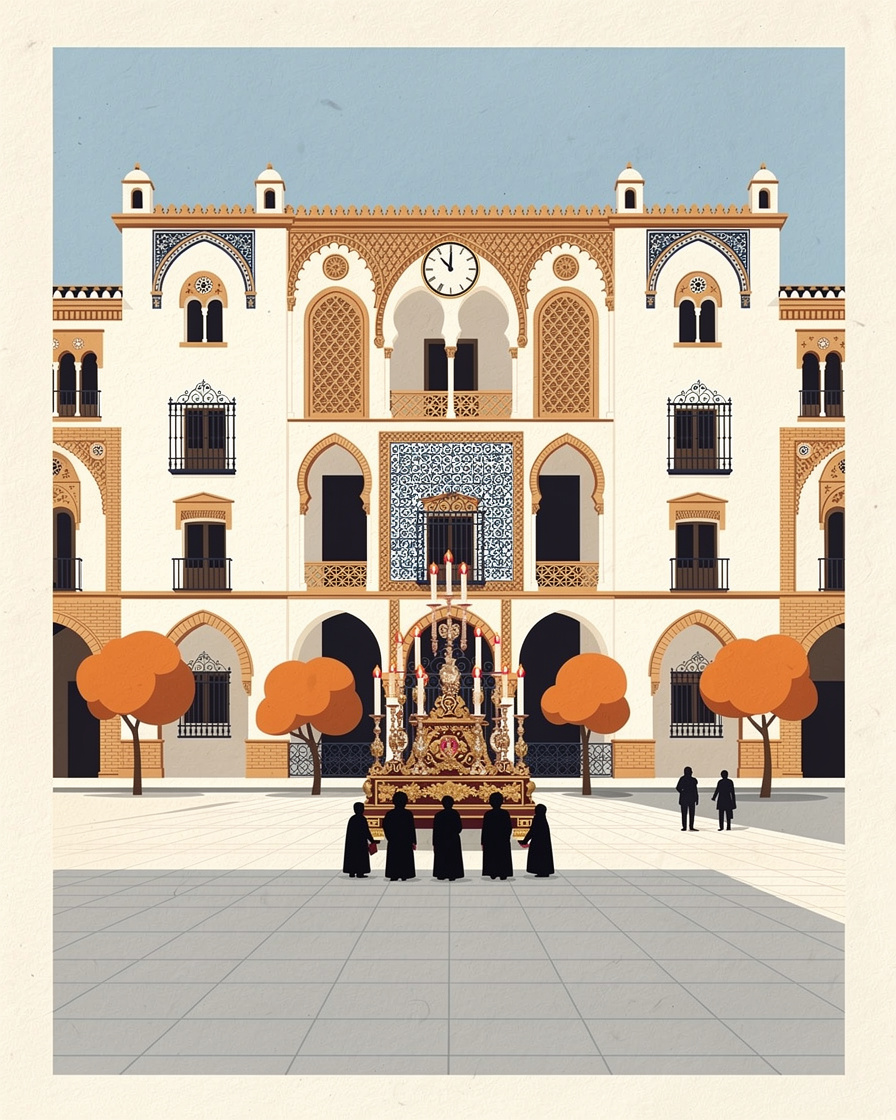
What do the 2026 times look like, day by day?
| Day | Brotherhood | Published times |
|---|---|---|
| Viernes de Dolores | Padre Pío | Leaving at 15:10 and back in at 0:30 |
| Viernes de Dolores | Torreblanca | Leaving at 16:45 and back in at 1:00 |
| Palm Sunday | La Borriquita | Leaving at 14:15, the Campana at 15:35, the Cathedral at 17:00 and the palio back in at 22:00 |
| Palm Sunday | La Cena | Leaving at 14:00, the Campana at 15:50, the Cathedral at 17:20 and back in between 21:15 and 22:00 |
| Holy Tuesday | El Cerro | Leaving at 11:40, the Campana at 16:40, the Cathedral at 18:05 and back in between 1:00 and 2:00 |
| Madrugá | The night brotherhoods | Departures between 0:00 and 3:00 and returns between 7:00 and 13:00 |
| Holy Saturday | El Sol | Leaving at 12:45, the Campana at 17:15, the Cathedral at 18:40 and the palio back in at 22:55 |
| Easter Sunday | La Resurrección | Leaving at 8:30, the Campana at 10:55, the Cathedral at 12:25 and the palio back in at 16:30 |
The times in the table are those published by El País on 27 March 2026 and by 20minutos and Idealista in March 2026, all taken from the official list. The eve days fall on Viernes de Dolores, 27 March, and Sábado de Pasión, 28 March 2026 and the main week runs from 29 March to 5 April 2026.
What happens when the newspapers disagree?
La Borriquita is the clear case. El País publishes leaving at 14:15, the Campana at 15:35, the Cathedral at 17:00 and the palio back in at 22:00; 20minutos, leaving at 14:35 and back in at 18:25.
Twenty minutes' difference in the departure is a copying error; almost four hours in the return suggests one of them is confusing the return of the leading cross with that of the palio, or one brotherhood with another.
The rule is simple: between two newspapers, the Council's PDF wins. And between the PDF and the street, the street wins, because rain or an incident changes the times on the spot without any record afterwards. The media rebuild their own tables from the list and often differ by a few minutes.
The Holy Week 2026 itinerary explains how to read the passing times for each street, and the programme PDF page where each document is.
Knowing when a brotherhood passes does not tell you which corner to watch from, or how early to get there. A brotherhood guide knows that, and brotherhood-themed tours exist precisely for that week. You can compare them with the city's other activities in a single catalogue.
See guided tours in Seville →Affiliate link: booking through it helps keep this guide going, and costs you nothing extra.What are the metro and TUSSAM bus hours during Holy Week 2026?
The metro extends its service all week according to okdiario, based on the operator's plan. Palm Sunday, 7:30 to 2:00. Holy Monday, Tuesday and Wednesday, 6:30 to 2:00. Maundy Thursday and the Madrugá, non-stop service from 7:30 on Maundy Thursday, and on Good Friday until 2:00.
Holy Saturday, 7:30 to 2:00. There are restrictions at Puerta Jerez station, with no published times.
TUSSAM, the city bus company, steps up its service by around 20% and starts at 6:00 on Holy Monday, Tuesday and Wednesday, and at 7:00 on the other days under the 2026 municipal plan. In 2024 the daytime service ended between 1:00 and 1:15 and the EA airport bus made its last departure at 2:00 from Archivo de Indias.
The old town is closed to private traffic between 10:00 and 2:00 the following morning and the official route is closed off two hours before the brotherhood passes. There is no special Holy Week fare on public transport, only extended hours. The guide to getting around Seville gives the fares and the park-and-ride guide where to leave a car.
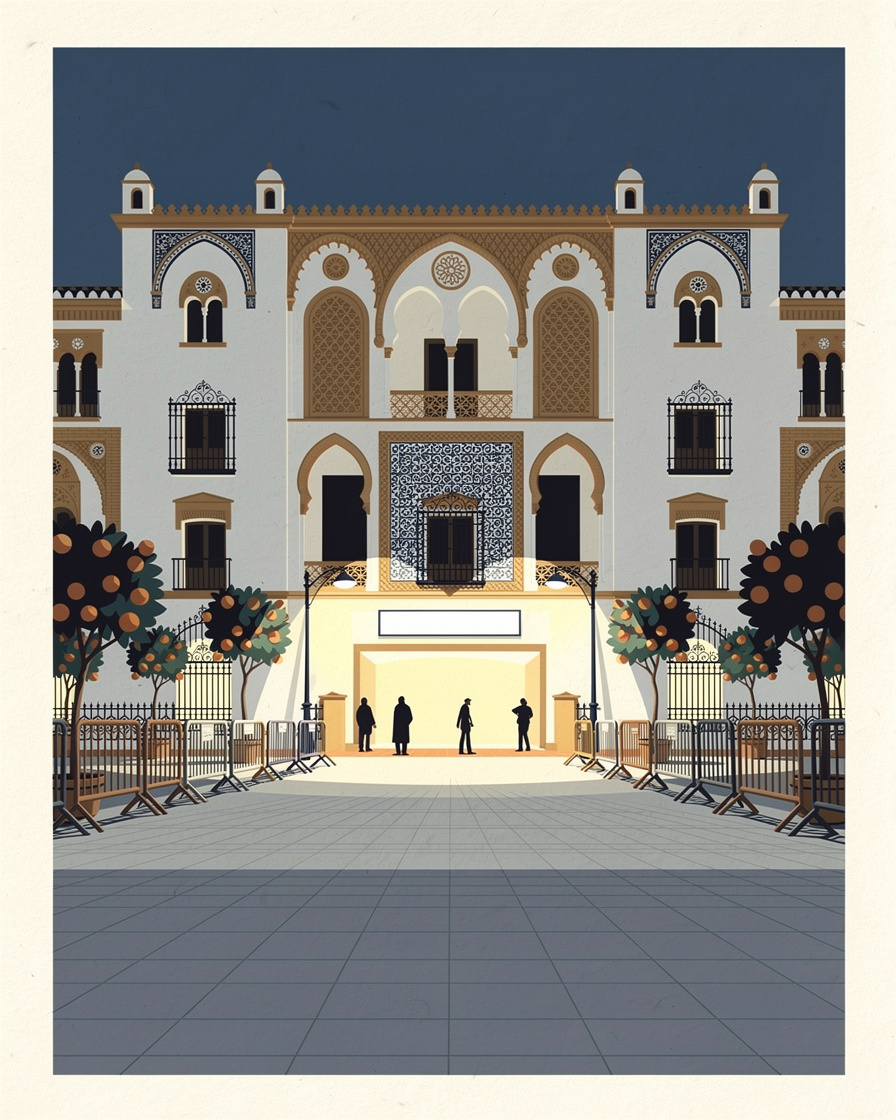
With returns at two in the morning, the last metro decides where you sleep. A hotel inside the pedestrian perimeter lets you watch a late return and go up to your room; one on the metro line, get back before 2:00. Outside those two options, there is the taxi with its Holy Week supplement. Comparing by neighbourhood with that time in mind changes your choice.
See places to stay for the Holy Week dates →Affiliate link: booking through it helps keep this guide going, and costs you nothing extra.When are the crowds at their worst?
The sources publish no hour-by-hour curves, but the time slots agree. The worst for getting around the centre is the Carrera Oficial slot, between 16:30 and 22:30, especially from Palm Sunday to Good Friday. The Madrugá is the densest of all, with peaks between 1:00 and 6:00 according to tradition and the press.
The mornings of Holy Monday to Wednesday, before 12:00, are the easiest: you see the preparations and some departures with few people about. The eve days in the neighbourhoods too, although there are already crowds. The areas to avoid at peak times are the Campana, Calle Sierpes, the area around the Cathedral and Puerta Jerez.
All of these are qualitative time slots. The general Holy Week guide gives the daily crowd figures that do exist and explains why there is no hourly data.
Where do the timetables come from?
The station of penance at the Cathedral, which forces all the times to be coordinated, has a specific precedent: the Way of the Cross to the Cruz del Campo set up in 1521 by Fadrique Enríquez de Ribera, Marquis of Tarifa. It ran from the Casa de Pilatos to the wayside shrine, over 997 metres that reproduced the distance from Pilate's house to Golgotha.
ABC considers it the true origin of modern Holy Week, while warning that the processions of the 14th to 16th centuries cannot be compared with today's.
Brotherhoods have existed in Seville since the 13th century, and the list approved by decree is the current form of a tradition of regulated timetables that no other Andalusian city has taken so far. In 2025 there were more than 130 processions over nine days.
What has not been published?
- A single table by neighbourhood, or an average time each street is occupied: only the line per brotherhood exists.
- Chair and box prices for 2026, which the timetable documents do not cover.
- The total number of nazarenos and costaleros in 2026: the media give examples, not a total.
- Monument opening hours cross-referenced with procession times.
- The exact restrictions at Puerta Jerez metro station.
For the rest of your trip, the guide to getting to Seville and the guide to where to stay complete the planning.
Outside Holy Week, none of these timetables exist and you can walk the centre at any hour. A three-star hotel costs between €90 and €150 a night outside the peaks, according to 2026 guides. If it is Seville you are after rather than the processions, any other week works out better and cheaper.
Compare places to stay in Seville by date →Affiliate link: booking through it helps keep this guide going, and costs you nothing extra.Sources
- Consejo General de Hermandades y Cofradías: Nómina Oficial Semana Santa 2026 (decree of 15 March 2026, PDF updated on 9 April 2026); Horarios y Recorridos.
- El País: Seville Holy Week 2026 programme, dates, times and routes (27 March 2026).
- 20minutos: Seville Holy Week 2026 guide, all dates and times. Idealista: what Holy Week in Seville 2026 will look like (17 March 2026).
- okdiario: Holy Week in Seville 2026, times, route, dates and metro hours (26 March 2026).
- Cadena SER: 46 brotherhoods with changes (15 March 2026). El Mundo: 71 brotherhoods (27 March 2026).
- Seville City Council: special Holy Week traffic plans for 2026 and 2024. El Correo de Andalucía: last EA departure in 2024. Diputación de Sevilla: how far ahead roads are closed.
- Visita Sevilla: Holy Week 2026 PDF; official 2024 guide with times by brotherhood; 2025 PDF of maps, times and planned routes.
- Sevilla Actualidad: complete guide to 2025 times and routes. La Línea Gusta: more than 130 processions in 2025.
- ABC de Sevilla: when Seville's Holy Week was born (updated in 2025). La Vanguardia: origin and evolution (15 April 2019).
The times are those published by the press from the official list and carry their year. When two outlets disagree, this page says so and refers you to the Council's PDF.
Frequently asked questions
What time do the brotherhoods pass along the Carrera Oficial in Seville?
Where is the official Seville Holy Week 2026 timetable?
What are the Seville metro hours during Holy Week?
How long does a procession last in Seville?
Rocío Delgado
Rocío grew up in the San Lorenzo neighbourhood and follows Holy Week from the madrugá, not from the stands. She knows the corners where you can watch a paso go by without waiting three hours, and the streets that close without warning. She never recommends a spot she has not stood in herself.