Seville map: the centre, the districts and real walking distances
Seville is a small city with a centre that jams. The districts one by one, the real walking minutes to the cathedral and the area that closes during Holy Week.
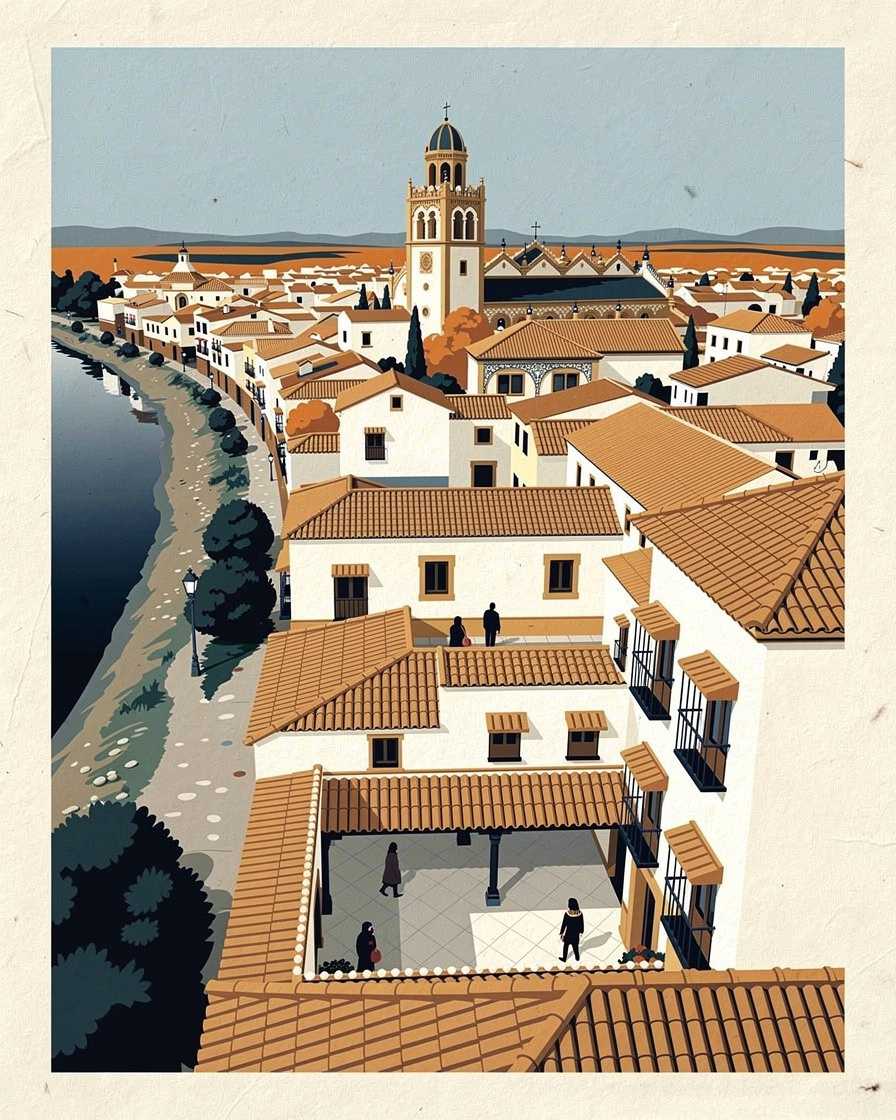
Seville is compact, and that is misleading. Almost everything worth visiting fits into a rectangle twenty minutes across on foot, but during Holy Week that same rectangle becomes the hardest place in Spain to cross.
This mental map does two jobs: choosing where to stay knowing how many real minutes you are from the cathedral, and understanding what closes, when and why.
The map below is interactive. Tap a number to see the name of the place, then Go for directions.
The city's skeleton in four pieces
To find your way around, you only need to remember four things, and the rest falls into place around them.
- The old town (Casco Antiguo), east of the river: the cathedral, the Alcázar, Santa Cruz, the Alfalfa, El Arenal, Santa Catalina. It is where almost everything is.
- The Guadalquivir, which separates the old town from Triana and Los Remedios. There are only bridges, and on crowded days that matters.
- The Carrera Oficial, the official route running through La Campana, Calle Sierpes, Plaza de San Francisco, Avenida de la Constitución and the cathedral. It is the heart of Holy Week and the point that seizes up.
- The modern ring: Nervión and Prado to the east, Macarena to the north, Los Remedios south of the river. Less touristy, better connected by car.
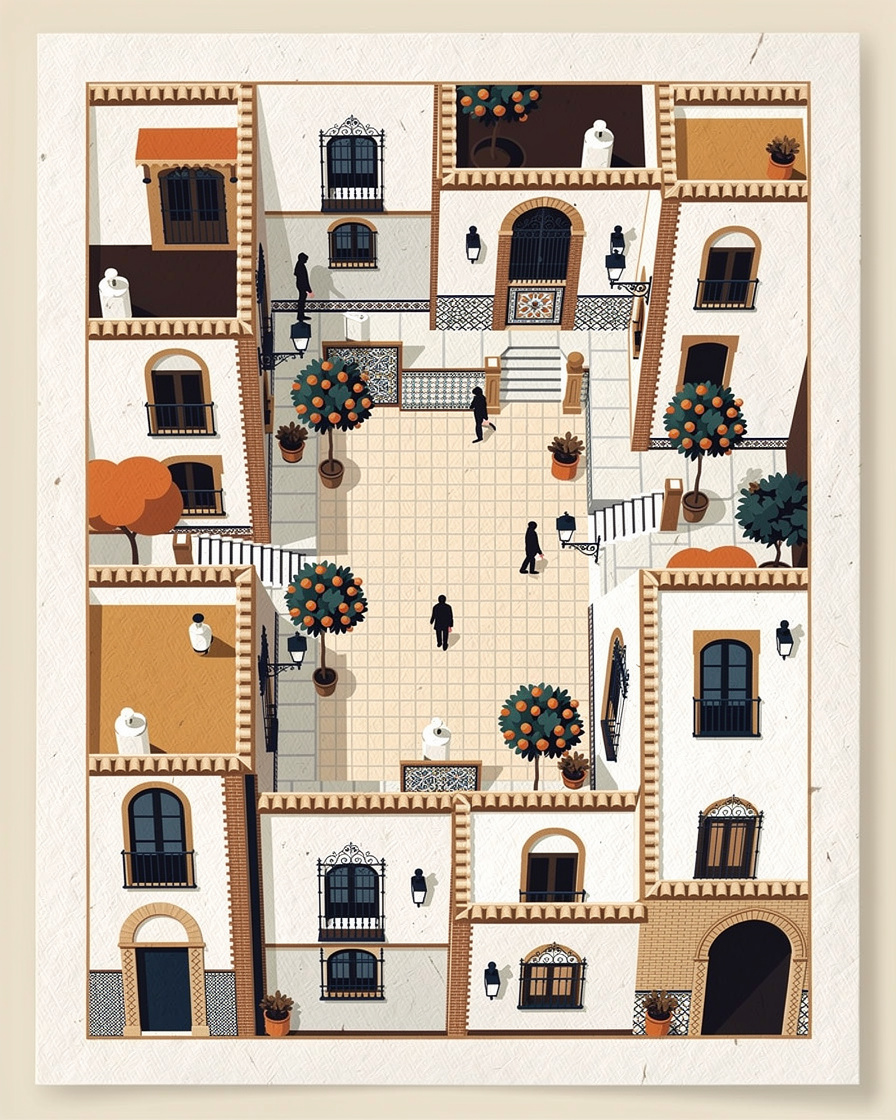
How far is each district from the cathedral, in minutes?
The word "central" means nothing on an accommodation listing. Walking minutes do. These are the distances used by specialist guides, measured from the cathedral.
| District | Walk to the cathedral | Character |
|---|---|---|
| Santa Cruz | 0 to 5 min | Very quiet, the priciest of the central districts |
| Centro, Alfalfa, old town | 5 to 10 min | Dense, bars open late |
| El Arenal | 7 to 10 min | Quiet at night, by the river |
| Santa Catalina, San Bartolomé | 10 to 15 min | Historic and calmer than Santa Cruz |
| Triana | 10 to 15 min | Across the river, a life of its own |
| Alameda de Hércules | 15 to 20 min | Young, noisy, cheaper |
| Nervión, Los Remedios | 20 to 30 min | Residential, metro and parking |
These are orders of magnitude published by guides in 2025 and 2026, not official measurements. Nobody publishes the distances in metres district by district, and it is worth saying so before anyone plans to the minute.
The rule that saves the most grief: before booking, check the walking time to the cathedral instead of trusting the word "central" on the listing. Ten minutes' difference changes the price, the noise at night and, in Holy Week, which side of the barrier you end up on.
See places to stay by district on Booking.com →Affiliate link: booking through it helps keep this guide going, and costs you nothing extra.The two sides of the river
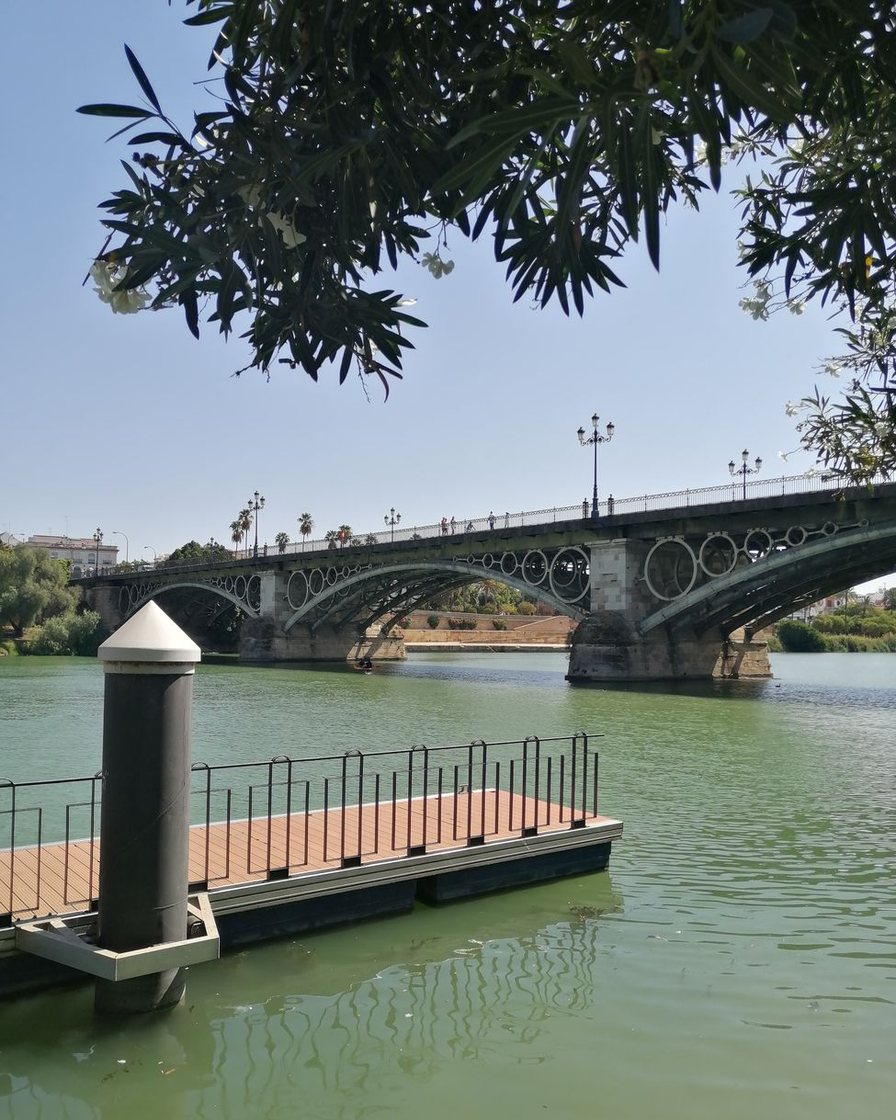
Triana is not an outlying district: it is ten to fifteen minutes' walk from the cathedral, over the Isabel II bridge. It has its own brotherhoods, its own riverside bars and a reputation for not being the centre, which it defends with pride.
Los Remedios, south of Triana, is the modern district where the April Fair is set up. It is residential, with wide streets and easier parking, and in Holy Week it is well outside the jam.
The trade-off is simple: you only cross the river by bridge. When the centre is packed and so are the bridges, those fifteen theoretical minutes turn into forty real ones.
The area that closes during Holy Week
This is where the map stops being a tourist map and becomes an operational one. The special mobility plan sets out an area and a timetable, and inside them the city works differently.
- La Campana is closed completely from Tuesday 24 March at 10:00 until Easter Sunday.
- The old town restricts access between 10:00 and 2:00 the following morning on the busiest days.
- The streets on the official route and those next to it close two hours before the brotherhood passes and stay closed until it has gone by.
- From Maundy Thursday at 10:00 to Holy Saturday at 2:00, access is practically limited to deliveries under security conditions.
Only residents with a registered garage, emergency services, public transport and taxis, vehicles of people with reduced mobility and hotel guests with a prior booking can get in. That last category is the one most people have never heard of.
The centre fills up from 19:00 onwards, to the point where getting from La Campana to the cathedral in a reasonable time is no longer possible. That is not brochure exaggeration: it is the reason the mobility plan exists.
Distances stretch, and nobody warns you
It is the least talked-about effect of Holy Week in Seville. A paper map says Triana is fifteen minutes from the centre, and that map tells the truth every other day of the year.
With the barriers up, the brotherhoods in the street and the closures shifting as they advance, the same walk can take two or three times as long. The city does not change size, it changes shape.
In practice, it is better to pick one side and stay there for the evening, rather than planning three trips across. Locals do exactly that, and not by chance.
What no map publishes
- The exact distances in metres between the districts and the cathedral. There are only estimates from guides, with no mapping to back them up.
- A list of closed streets hour by hour in a readable format. Annual maps exist, but they are technical and only in Spanish.
- Unplanned closures because of crowds, security or rain: they are announced live and never consolidated anywhere.
- An accessible route for people with reduced mobility during Holy Week. The plan mentions the access exemption for their vehicles, but publishes no walkable routes.
With the map in your head, the next step is choosing the district: it is in the guide to where to stay, district by district. To come in from the outskirts, see the park-and-ride car parks and public transport fares. And if you are driving, the parking zones and their prices.
In Holy Week, the map becomes a booking decision: sleeping inside the closed area means walking in at any hour, and sleeping outside means depending on bridges and diversions that change every evening. Both options can be defended, but not at the same price or with the same notice.
See places available for the peak dates →Affiliate link: booking through it helps keep this guide going, and costs you nothing extra.Sources
- Seville City Council, sevilla.org: Holy Week 2026 special mobility plan, mobility plan notice and 2026 local security board.
- Diario de Sevilla: getting around during Holy Week 2026.
- Vozpópuli and Sevilla Informa: timetables, routes and road closures for Holy Week 2026.
- Moris Insider: walking times by district (2026).
- Heather on her Travels: checking the walking time to the cathedral (2024).
- Housing Anywhere: guide to Seville's districts (2026).
- Consorcio de Transportes de Andalucía and Metro de Sevilla: transport coverage by district.
The closed area and its hours are approved every year in the special mobility plan. This page is reviewed with each new edition of the plan.
Frequently asked questions
How long does it take to walk from Triana to Seville Cathedral?
Which areas of Seville are closed during Holy Week?
Which is the most central district of Seville?
Marta Bermúdez
Marta spent five years on the front desk of a hotel in the centre, answering the same questions about parking and the metro every day. She writes the pages she would have liked to hand to her guests. She checks every fare on the operator's website, never in a guidebook.